
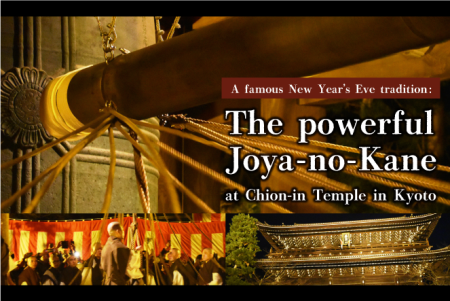
The powerful Joya-no-Kane at Chion-in Temple in Kyoto
A common event on New Year’s Eve in Japan is Joya-no-Kane (the New Year’s bell).
When the NHK year-end music show Kohaku Uta Gassen is near the end, you can often hear bell sounds from far away. This is a classic New Year’s Eve scene in Japan.
After the show ends, another TV program, Yuku Toshi Kuru Toshi, shows New Year’s bells from many places across Japan. Every year, the powerful bell at Chion-in Temple is often featured.
About 30,000 people gather each year. It is not an exaggeration to say it is one of the most famous in Japan. I went to see the huge temple bell at Chion-in Temple rung for Joya-no-Kane.
From 2025, the Joya-no-Kane viewing at Chion-in Temple became paid and requires an advance application.
To watch, you need either:
- an online reservation from the official website starting Dec 1, or
- an in-person reservation at the Chion-in Yuzen-en reception starting Dec 8.
There are four time slots, 500 people each, for a total of 2,000 people. The online slots filled up quickly.
What is Joya no Kane?
First, let’s look at what “Joya no Kane” is.
What does Joyа mean?
First, what does “joya” in “Joya no Kane” mean?
“Joya” means the night of “jojitsu.”
“Jojitsu” means “the day to remove the old year.” It is the same as New Year’s Eve, December 31.
Just like “Gantan” means the morning of New Year’s Day, “joya” means the night of New Year’s Eve.
The history of Joya no Kane
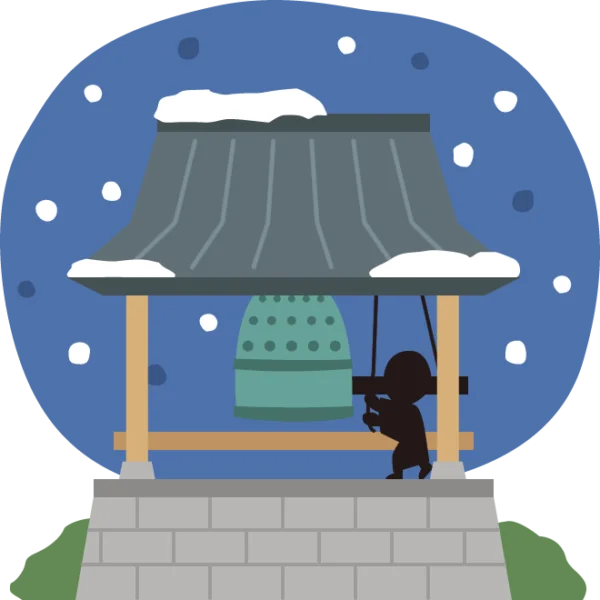
The culture of celebrating the last day of the year as “joya” (or “New Year’s Eve”) is not only in Japan. It also exists in East Asia, such as China, Korea, and Vietnam, where Chinese characters are used.
Surprisingly, it is not directly connected to Buddhism that started in India.
The custom of hitting a temple bell on New Year’s Eve started in China and came to Japan in the Kamakura period.
However, “Joya no Kane” becoming common like today is not very old. Up to the Edo period, records about it are only in small pieces, and it was not a popular public event like it is now.
It began to spread after the Meiji era, and it is said to have become widely common from the 1930s (Showa era).
Around the same time, radio became popular, and the New Year’s Eve bell was broadcast nationwide. This was a big reason it spread.
So even though it feels like a very old tradition, “Joya no Kane” is actually fairly new.
Also, in China, where it started, the custom has almost disappeared, so today it is mostly a Japanese New Year’s Eve event.
Why ring the bell 108 times?
“Joya no Kane” is usually rung 108 times.
People often say this is to remove the 108 worldly desires in Buddhism.
Another idea is that 108 is the total of 12 (months) + 24 (solar terms) + 72 (seasons/markers).
In any case, “Joya no Kane” is not very strongly tied to Buddhist teaching, and the number 108 is not that important.
Some temples do not count the exact number, so that every visitor can ring the bell. That is also fine.
When is Joya no Kane rung?
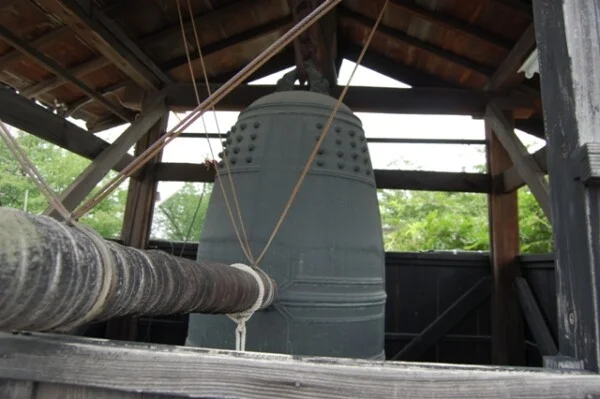
Joya no Kane is rung from the old year into the new year, and the timing is usually one of these patterns:
- Ring 107 times before midnight, then 1 time after the new year starts
- Start ringing only after the new year begins
- Start at a set time before midnight, ring across midnight, and finish in the new year
Some people say the first pattern is the “proper” one, but there is no strict rule.
Including Chion-in Temple, the third pattern is the most common.
Chion-in Temple Joya no Kane report
On December 31, 2018, I went to see the “Joya no Kane” at Chion-in Temple.
A powerful and acrobatic bell ringing
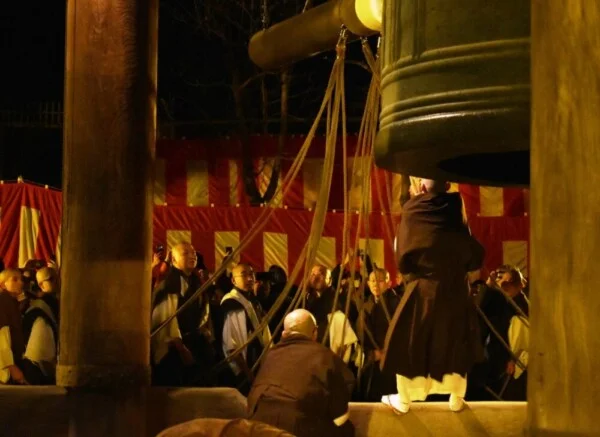
As you may know from the TV program “Yuku Toshi Kuru Toshi,” the temple bell at Chion-in Temple is so huge that it is rung in a special way.
There are 17 bell ringers.
This includes 1 person holding the main rope, and 16 people holding the other ropes.
The main rope leader is the star, and his movements are very acrobatic.
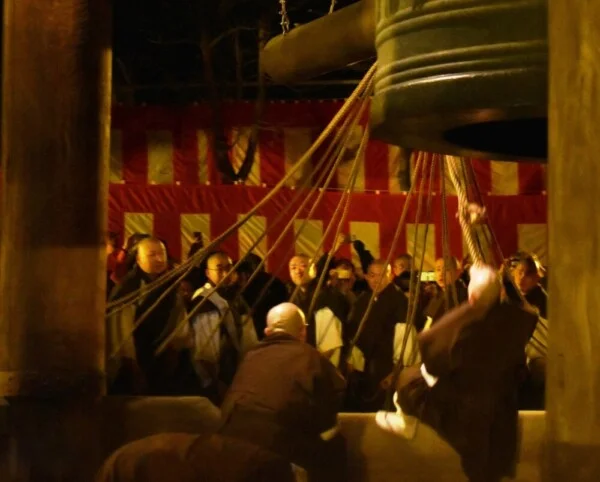
The ringers on the side ropes pull back the wooden beam a few times, building up power little by little.
Then the main rope leader calls out, “E~i, hito~tsu!”
The 16 side-rope ringers repeat the same words and pull the beam far back together.
When everyone chants “So~re,” the side-rope ringers loosen the ropes. At the same time, the main rope leader uses the rebound, almost throwing his whole body forward, and strikes the bell with full force.
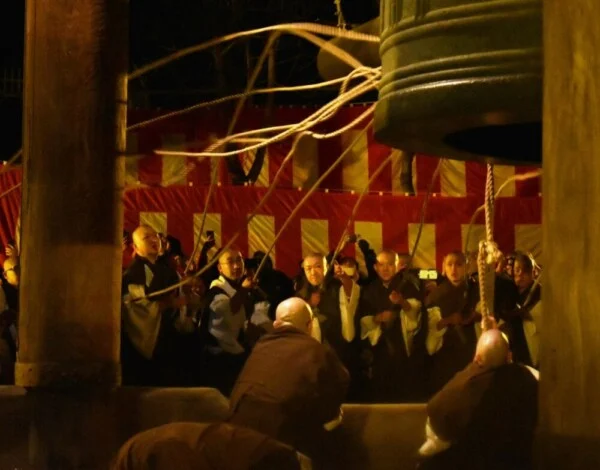
At the moment of the strike, the side ropes bend and flex heavily.
It’s an easy way to see how powerful and fast the hit is.
From the point where you enter in front of the large bell tower, the view turns half a circle. This is what it looks like from the bell ringers’ side.
You can clearly see the wooden beam swing with strong force and slam into the bell.
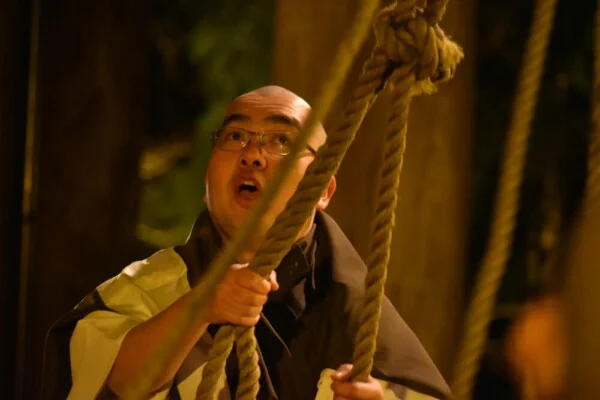
The main rope leader faces the opposite side of the bell, so you can clearly see his facial expression.
Joya no Kane is usually rung at a pace of a little over once every minute.
Because the main rope leader’s role is very hard physical work, they usually switch leaders every 3 strikes. The side-rope ringers who pull the wooden beam do not need as much strength. The reason there are 16 of them is that it matches the idea of the Sixteen Arhats.
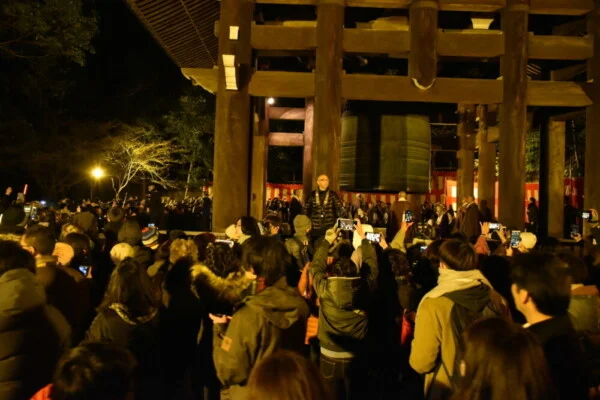
Ending
On New Year’s Eve, a great way to finish the year is with Joya no Kane.
In Kyoto on New Year’s Eve, trains and some city buses run all night, but there are fewer services, so travel can take more time.
However, taxis are still easy to use, just like usual.
If you use taxis well, you can visit not only Chion-in Temple, but also several places to see more than one Joya no Kane.
At Chion-in Temple, the bell ringing is special and you mainly watch it. But in many other places, you can also find bells that visitors can ring themselves.
Let’s end 2025 with Joya no Kane!
For sightseeing in Kyoto, leave it to MK’s chartered sightseeing taxi.
Your private driver is a Kyoto expert who handles both transport and guiding.
