
Best Places to See Plum Blossoms: Eastern Kyoto area
This article highlights hidden plum blossom views in Rakuto, the eastern part of Kyoto.
Chishaku-in Temple (Higashiyama Ward) Late February to mid-March
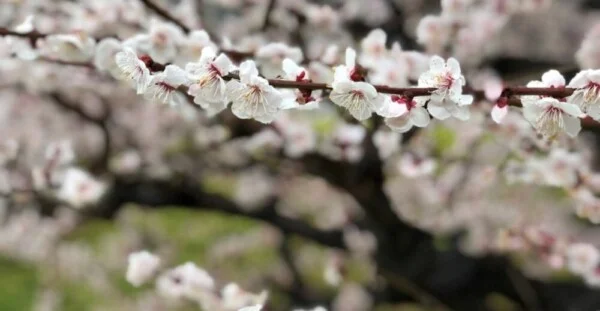
Gorgeous red plum blossoms and clean, simple white plum blossoms
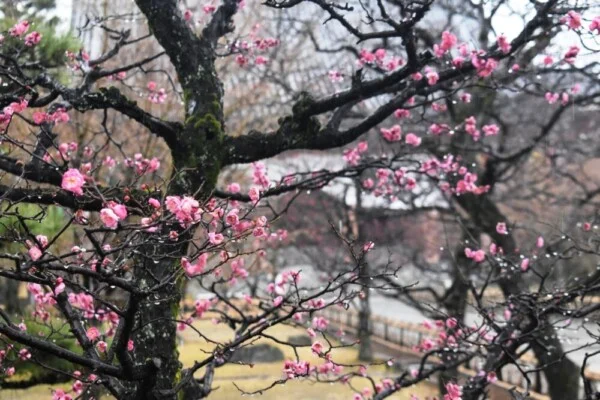
Chishaku-in Temple is decorated with beautiful flowers all year round, but the main star in early spring is plum blossoms.
The plum grove on both sides of the path leading to the Kondo Hall is wonderful.
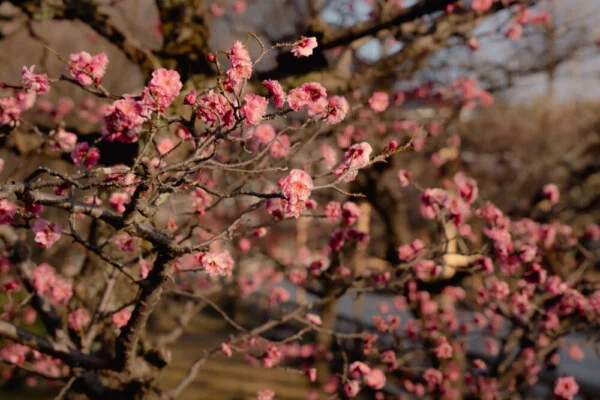
The plum blossom area at Chishaku-in Temple is freely open, so you can enjoy it for free from early morning until sunset.
The plum blossoms look beautiful in the morning sun and the evening light.
Early-blooming plums usually start flowering from January, but most plum trees begin to bloom around mid-February.
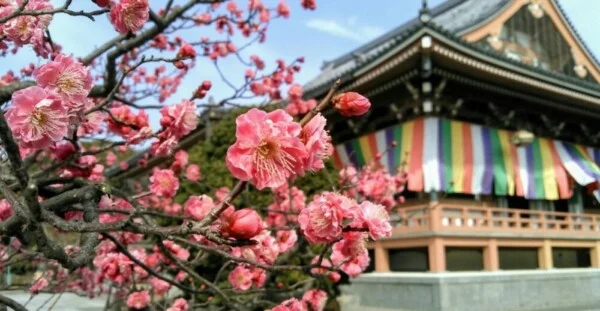
Red and white plum trees line the area from the admission desk to the front of the Kondo Hall.
Plum trees are also planted here and there around the temple grounds.
Most of the trees are still short and are still growing, so they will get bigger in the future.
Many different kinds of plum trees are planted here. Their peak times are slightly different, but in most years, around mid-March, the plum trees along both sides of the approach path are at their best.
Glossy deep-red plum blossoms and clean, gentle white plum blossoms give a strong feeling of spring.
When people talk about Chishaku-in’s paintings, the best-known works are the “Maple Painting” and the “Cherry Blossom Painting” by Hasegawa Tohaku and his son Kyuzo.
Besides these, at the Treasure Museum you can also see “Pine and Plum,” a painting of plum blossoms.
The artist is unknown, but some say Hasegawa Tohaku may have drawn the preliminary sketch.
Visitor Information
- Hours
Treasure Museum & Scenic Garden: 9:00–16:30 (last admission 16:00)
Approach path: open during the day
The approach path is a free area inside the grounds. - Admission Fee
Scenic Garden:
Adults: 500 yen
Junior high / High school: 300 yen
Elementary school: 200 yen - Treasure Museum:
Adults: 500 yen
Junior high / High school: 300 yen
Elementary school: 200 yen - TEL: 075-541-5363
- Address: 964 Higashikawara-cho, Higashiyama-ku, Kyoto
- Access:
Kyoto City Bus “Higashiyama-Shichijo”: a short walk
Keihan “Shichijo” Station: 10-minute walk
Kiyomizu-dera Temple (Higashiyama Ward) Mid-March
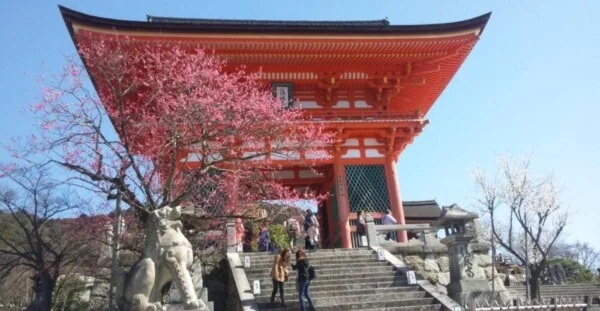
Red and white plum blossoms that stand out at the Niomon Gate.
Kiyomizu-dera, one of Kyoto’s most famous sightseeing spots, is also a small place to enjoy plum blossoms.
The red and white plum trees in front of the Niomon Gate at the entrance usually start to bloom around March, and they are highly recommended.
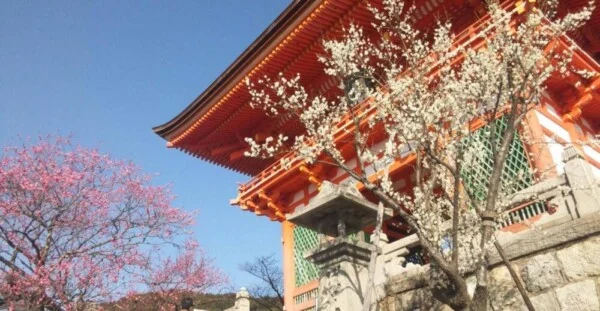
It is a beautiful gate, also called the “Red Gate.”
If you look back from the gate, you can see a wonderful view of Kyoto city.
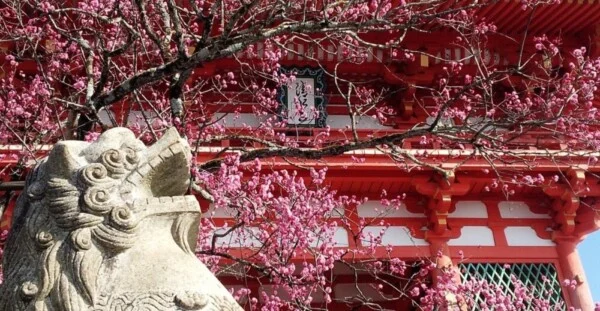
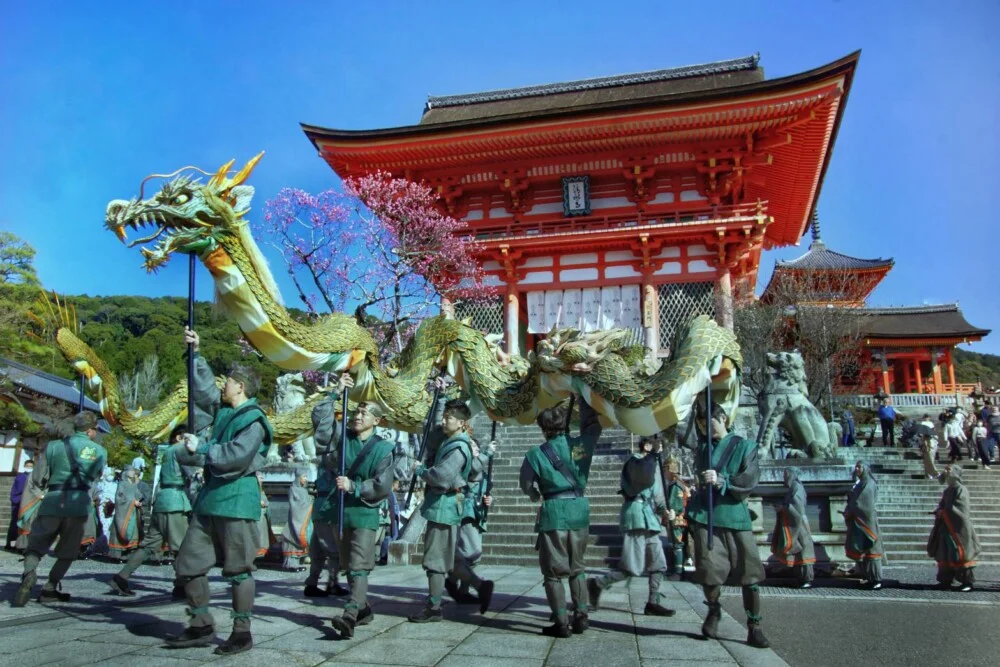
Seiryue: A blue dragon parade with red plum blossoms in the background
At Kiyomizu-dera, Seiryue is held every year on March 15, April 3, and September 15.
It is an event that started in 2000, led by people from the area in front of the temple.
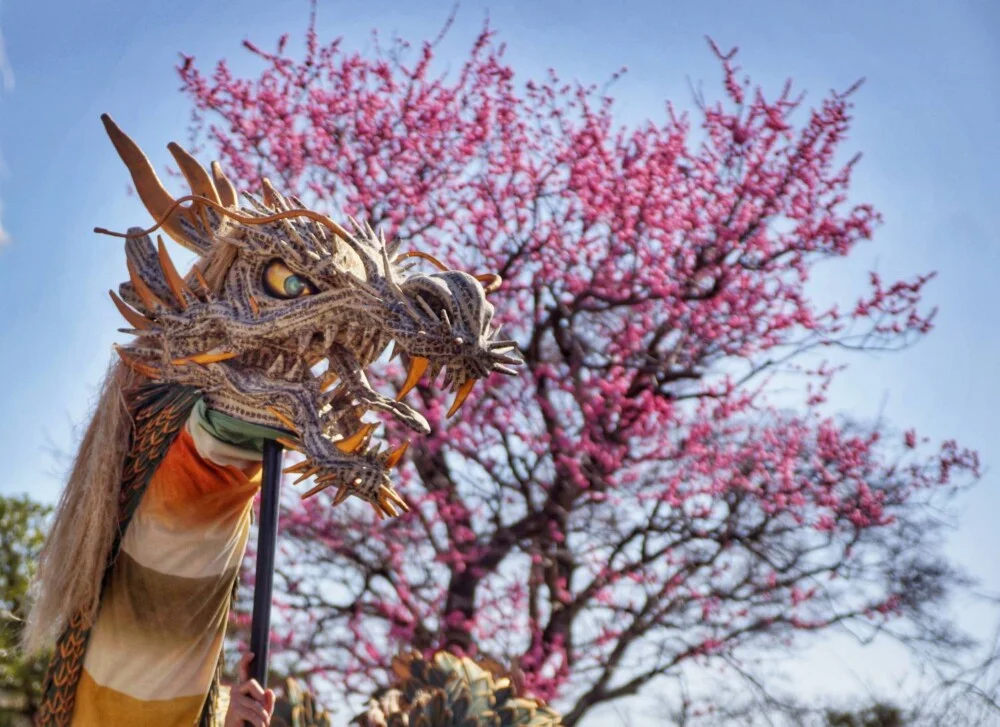
In Seiryue, a dragon believed to be an incarnation of Kannon Bodhisattva parades through the Kiyomizu-dera grounds and the temple town, praying for local safety and to ward off disasters.
The highlight is the scene of an about 18-meter-long blue dragon leading the way, followed by around 50 people in traditional costumes as they climb the stone steps.
The Seiryue on March 15 usually takes place when the red plum blossoms in front of the Niomon Gate are at their best.
With the vermilion Niomon Gate and the red plum blossoms behind it, the sight of the blue dragon moving forward is stunning.
Visitor Information
- Hours: 6:00–18:00
- Admission:
Adults: 500 yen
Elementary & Junior high: 200 yen - TEL: 075-551-1287
- Address: 1-294 Kiyomizu, Higashiyama-ku, Kyoto
- Access:
25-minute walk from Keihan “Kiyomizu-Gojo” Station
10-minute walk from Kyoto City Bus “Gojo-zaka” stop
Yasaka Koshindo (Higashiyama Ward) Late February to early March
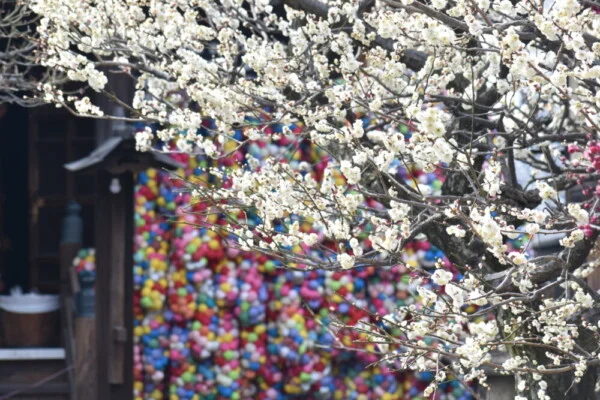
When the white plum blossoms bloom, it looks even more Instagrammable
Yasaka Koshindo is famous for the “kukurizaru.” The colorful kukurizaru are very popular because they look great in photos.
The temple is photogenic all year round, but the best time is actually early spring.
From late February to early March, beautiful white plum blossoms are at their best in the temple grounds.
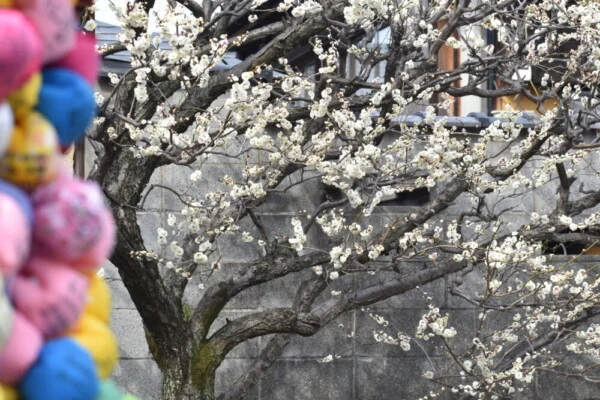
There are many kinds of plum blossoms, but the ones at Yasaka Koshindo are pure white.
They look surprisingly great with the colorful “kukurizaru.”
I really hope you can come and enjoy this beauty.
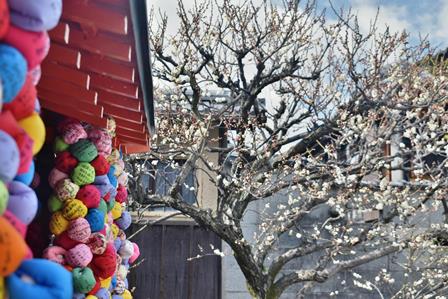
The main deity of Koshindo is Shomen Kongo, and it is said that monkeys serve him.
Since long ago, there has been a custom of hanging monkey-shaped dolls to ward off misfortune.
They are also called “sarubobo” or “migawari-zaru,” but at Yasaka Koshindo they are called “kukurizaru.”
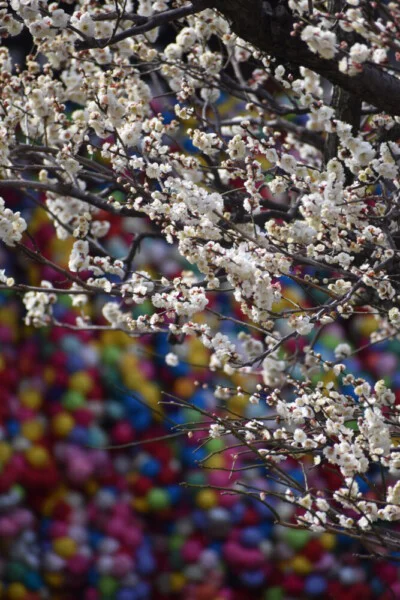
At Yasaka Koshindo, many colorful “kukurizaru” are offered.
They look bright and beautiful, so the temple has become a popular photo spot for Instagram.
Visitor Information
- Hours: 9:00–17:00
- Admission: Free (grounds are open)
- TEL: 075-541-2565
- Address: 390 Kinen-cho, Higashiyama-ku, Kyoto
- Access: 7-minute walk from Kyoto City Bus “Gojo-zaka” stop
Gion Shirakawa (Higashiyama Ward) Early to mid-March
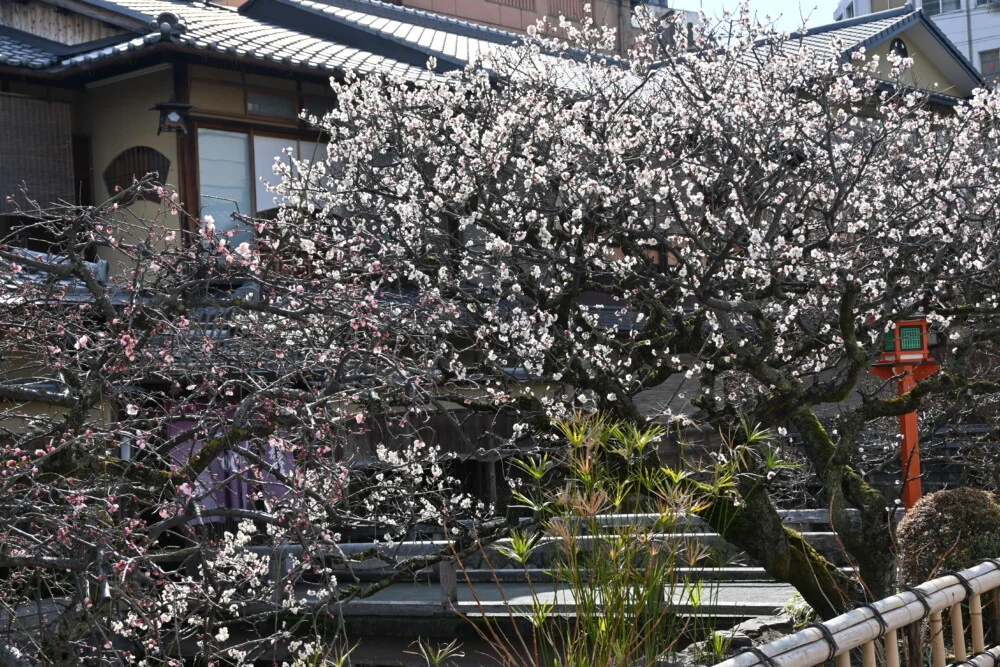
Along the Shirakawa River, which is fed by water from Mt. Hiei and Mt. Daimonji, plum trees are planted here and there.
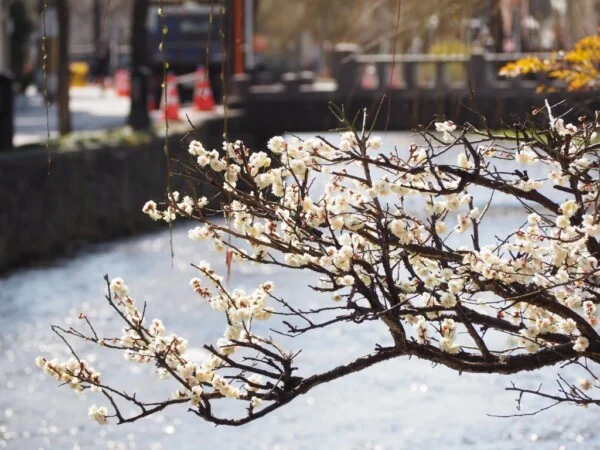
The beautiful plum blossoms blend into the charming townscape.
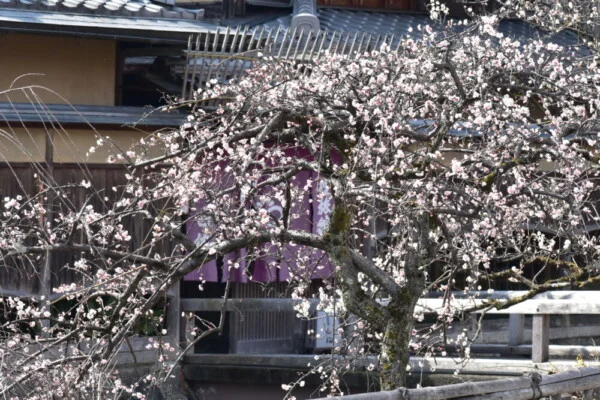
The bridge over the Shirakawa River is inside the property of the ryokan restaurant “Hakubai.”
When you enjoy the plum blossoms, do not enter the property—please view them from the road side.
The name “Hakubai” also comes from an old white plum tree that the previous owner, the former head hostess loved.
There is another white plum tree just to the east, but it blooms a little later.
Because this is a tourist spot, there are many foreign visitors.
In front of the white plum blossoms at their best time,
you can often hear conversations like this:
“What flower is this?”
“It’s a plum blossom.”
Strictly speaking, plum means a plum fruit, not a Japanese ume.
However, because there is no ume flower in Western countries,
it is often translated as plum to make it easier to understand.
From a botanical point of view,
ume is actually closer to apricot than to plum,
so it is sometimes translated as apricot.
Conclusion
Throughout the year, plum blossoms are the next most popular after cherry blossoms and autumn leaves. However, compared with cherry blossoms and autumn leaves, there is not much information about plum blossoms.
But MK Taxi sightseeing drivers have a lot of knowledge about plum blossoms, too.
We introduced four places this time, but each driver also has their own personal recommendations.
They can guide you not only in Kyoto, but across the Kansai region as well.
With an MK sightseeing charter taxi, you can enjoy Kyoto’s plum blossoms to the fullest.
Why not try a different kind of Kyoto trip with a professional guide and driver?
For sightseeing in Kyoto, leave it to MK’s chartered sightseeing taxi.
Your private driver is a Kyoto expert who handles both transport and guiding.
