
Best Places to See Plum Blossoms: Southern Kyoto area
Among Kyoto’s four seasons, plum blossoms are very popular, after spring cherry blossoms and autumn leaves.
Plum blossoms brighten early spring, and their beauty and scent have attracted visitors to Kyoto for a long time.
However, unlike cherry blossoms and autumn leaves, Kyoto is in the off-season from February to March, so it is not very crowded.
Many people who know Kyoto well say that plum blossoms are better than cherry blossoms if you want a calm and slow flower-viewing trip. Now, here are some recommended plum blossom spots.
In Raku-nan, the southern area of Kyoto, there are many famous plum blossom spots. One of the most popular is Jonangu Shrine, known for its weeping plum trees, which are even as popular as Kitano Tenmangu Shrine. You can also find beautiful views here that you can only see in this area.
Fushimi Inari Taisha Shrine (Minami Ward) | Late February to mid-Marc
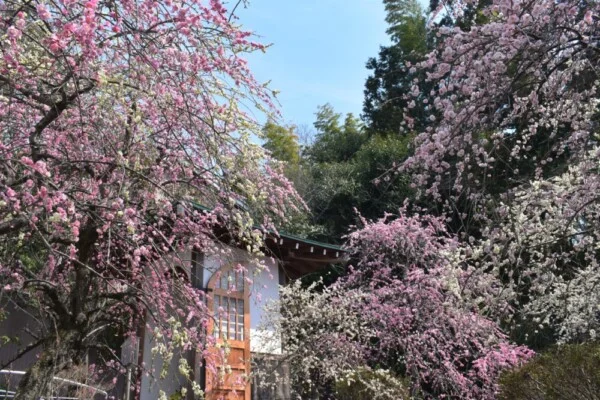
A weeping plum garden on the back approach
Fushimi Inari Taisha has a weeping plum garden that is not well known.
It is about 100 meters up from the entrance of the back approach, behind the Shakado Hall in the Kihokyo Soshinen garden.
The elevation is about 55 meters, about the same as the Senbon Torii area. In the large grounds of Fushimi Inari Taisha, it is in an easy-to-reach location.
During the best season for the weeping plum trees, you can spot red and white blossoms from the back approach, so you should be able to find it.
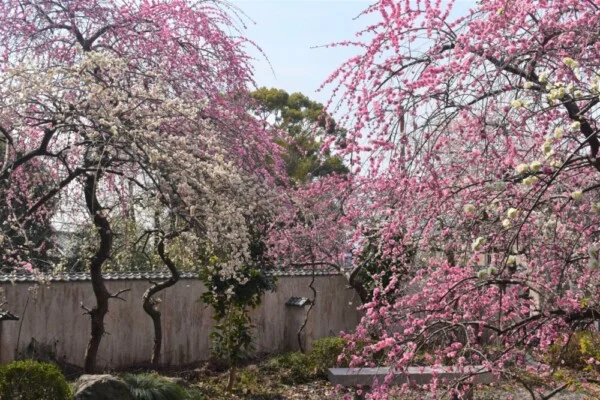
It is not a large open area, but there are about 20 weeping plum trees. They usually reach their best season from late February to mid-March.
There are also benches, so you can relax and enjoy the plum blossoms.
Because it is a hidden spot, it is usually not very crowded.
Visitor Information
Hours: Open during the daytime (any time)
Admission: Free entry to the shrine grounds
TEL: 075-641-7331
Address: 68 Fukakusa Yabunouchicho, Fushimi-ku, Kyoto
Access: Right near JR “Inari” Station
Kihokyo Soshinen Garden: About a 6-minute walk from JR “Inari” Station
Jonangu Shrine (Fushimi Ward) | Late February to mid-March
Plum blossoms that will change how you see them: a garden full of weeping plums
Jonangu Shrine is a recommended spot where you can enjoy plum blossoms that feel quite different from other places in Kyoto, such as Kitano Tenmangu Shrine.
The main star here is the weeping plum.
In Jonangu’s garden, the weeping plums usually start blooming in mid-February, in an area called “Haru no Yama” (Spring Mountain).
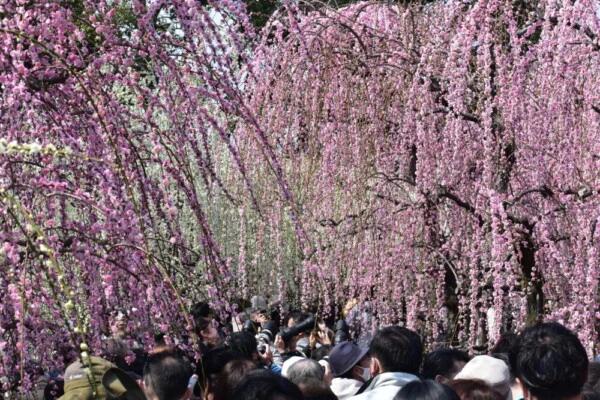
Every year in late February, the weeping plum trees start to reach their best season.
At Jonangu Shrine, the Weeping Plum and Camellia Festival is held from around late February to mid-March.
In 2026, it is scheduled for Wednesday, Feb 18 to Sunday, Mar 22.
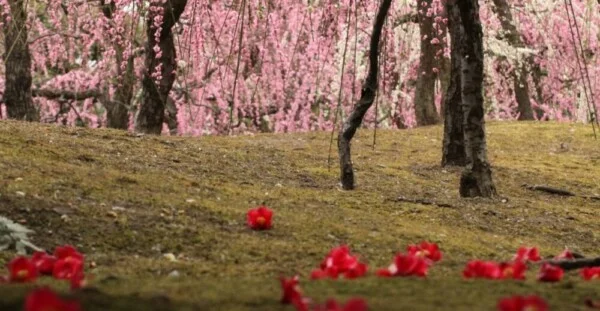
As the name “Weeping Plum and Camellia” suggests, not only the 150 weeping plum trees but also camellias—32 varieties—are a main highlight.
The scene of fallen Jonan camellia petals under the weeping plum trees is one of Jonangu’s most famous and popular views.
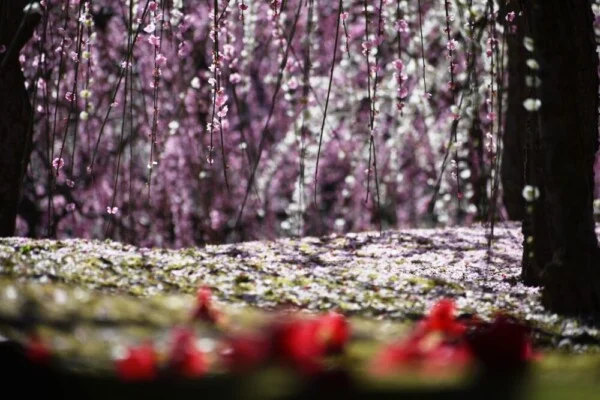
At Jonangu Shrine, several types of weeping plum trees are planted, including pink and white varieties.
Visitor Information
Hours: 9:00–16:30 (last entry 16:00)
Admission: Adults ¥1,000 / Elementary school students ¥600
TEL: 075-623-0846
Address: 7 Nakajima Tobarikyu-cho, Fushimi-ku, Kyoto
Access: About a 15-minute walk from Kintetsu / Subway “Takeda” Station
Zuishin-in Temple (Yamashina Ward) — Mid to late March
Late-blooming red plum blossoms known as “Hanezuno Ume”
Ono Plum Garden at Zuishin-in Temple is the latest-blooming plum garden in Kyoto.
The plum blossoms here are called “Hanezuno Ume” and are closely linked to Ono no Komachi.
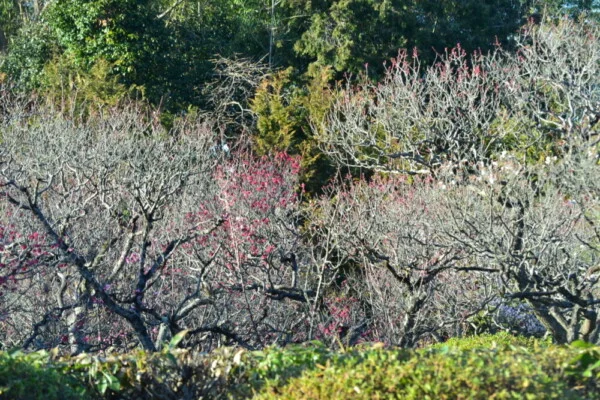
There are about 200 plum trees, mainly double-petaled red plums, and they usually start to bloom slowly in March.
The current Ono Plum Garden was developed into its present form after World War II.
Most of the “Hanezuno Ume” plum trees in Ono Plum Garden are the variety called “Maya Koubai” (Ma
“Hanezuno Odori” is held on the last Sunday of March
At Zuishin-in Temple, “Hanezuno Odori” is held every year on the last Sunday of March.
Long ago, local children had a tradition of dancing to a folk children’s song related to “Hyakuya-gayoi.” Inspired by that, this event started as a new tradition in 1973.
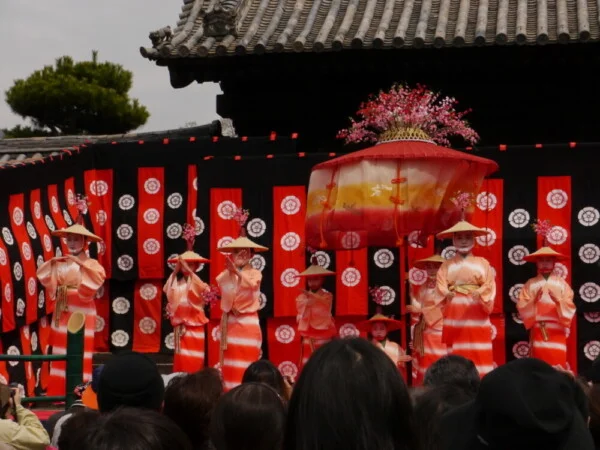
In 2026, Ono Plum Garden will be open from March 7 (Sat) to March 22 (Sun).
In 2026, the “Hanezuno Odori” performance will be held on March 29.
Visitor Information
Hours: 9:00–16:30
Admission: Temple visit ¥500 / Plum garden ¥500 / Combo ticket ¥800
TEL: 075-571-0025
Address: 35 Ono Goryo-cho, Yamashina-ku, Kyoto
Access: About a 5-minute walk from Subway “Ono” Station
Ono Plum Garden Opening (2026 info)
Period: Mar 7, 2026 (Sat) – Mar 22, 2026 (Sun)
Hours: 9:00–16:00
Garden entry: ¥300
Conclusion
Throughout the year, plum blossoms are the next most popular after cherry blossoms and autumn leaves. However, compared with cherry blossoms and autumn leaves, there is not much information about plum blossoms.
But MK Taxi sightseeing drivers have a lot of knowledge about plum blossoms, too.
We introduced four places this time, but each driver also has their own personal recommendations.
They can guide you not only in Kyoto, but across the Kansai region as well. With an MK sightseeing charter taxi, you can enjoy Kyoto’s plum blossoms to the fullest.
Why not try a different kind of Kyoto trip with a professional guide and driver?
For sightseeing in Kyoto, leave it to MK’s chartered sightseeing taxi.
Your private driver is a Kyoto expert who handles both transport and guiding.
