
Best Places to See Plum Blossoms: Western Kyoto area
Among Kyoto’s four seasons, plum blossoms are very popular, after spring cherry blossoms and autumn leaves.
Plum blossoms brighten early spring, and their beauty and scent have attracted visitors to Kyoto for a long time.
However, unlike cherry blossoms and autumn leaves, Kyoto is in the off-season from February to March, so it is not very crowded.
Many people who know Kyoto well say that plum blossoms are better than cherry blossoms if you want a calm and slow flower-viewing trip.
Now, here are some recommended plum blossom spots.
Umemiya Taisha (Ukyo Ward) | Late February to mid-March
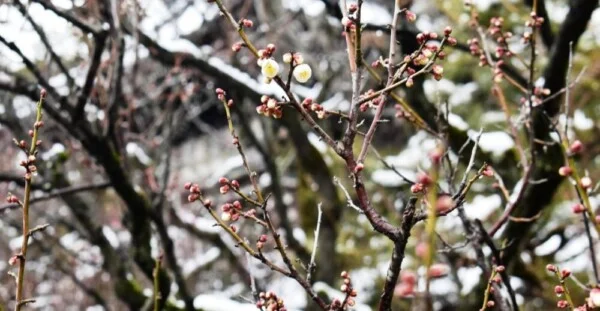
About 450 plum trees bloom in the shrine garden and grounds
However, even the written history about the shrine’s founding does not mention plum trees, so the reason for its link to plum blossoms is unclear.
Still, since it is called “Umemiya” Taisha, the shrine’s sacred flower is the plum blossom.
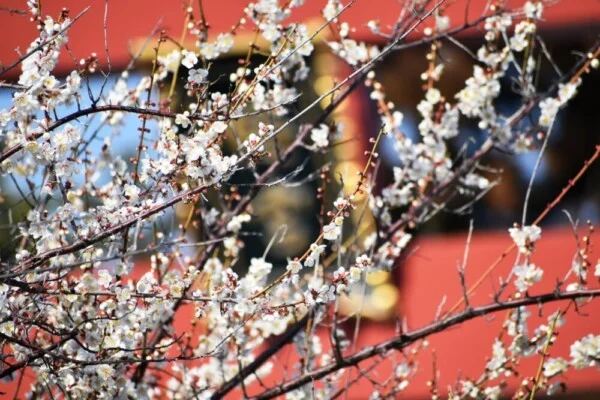
Plum trees are planted all around the grounds, such as in the shrine garden and in front of the main gate . Among temples and shrines in Kyoto, it has the second-largest number of plum trees after Kitano Tenmangu—about 450 in total—so it’s highly recommended for enjoying plum blossoms.
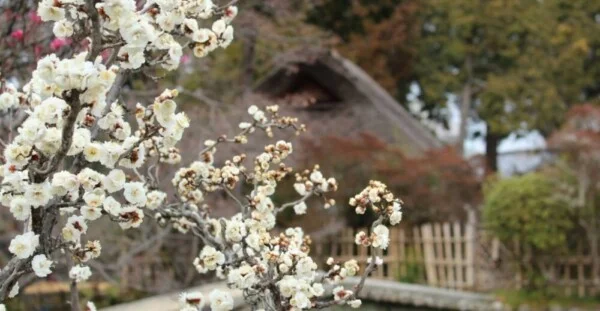
Usually, the grounds reach their best time in late February, and red and white plum blossoms bloom until mid-March.
From mid-March, the later-blooming weeping plum trees start to open, so even after the red and white plums fall, the best season continues until late March.
There are also about 50 kinds of camellias on the grounds, and you can enjoy them in the same season as the plum blossoms.
Visitor Information
- Hours: 9:00–17:00
- Admission: Adults 600 yen / Children 400 yen
- Tel: 075-861-2730
- Address: 30 Umezu Fukenogawa-cho, Ukyo-ku, Kyoto
- Access: About a 15-minute walk from Hankyu “Matsuo Taisha” Station
Shobo-ji Temple (Nishikyo Ward) | Early to mid-March
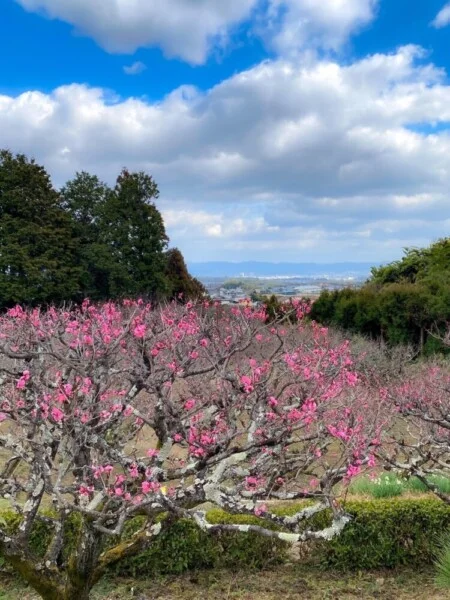
A plum grove spreads out on a spot that looks down over the Kyoto Basin
Did you know there is a quiet plum grove at the foot of the hills in Oharano, Nishikyo Ward?
Shobo-ji Temple has about 100 plum trees, with wide views over the Kyoto Basin behind it.
In the far distance, you can see a wide view of southern Kyoto City, including Fushimi-Momoyama Castle and Kyoto Tower.
It’s a view that feels different from other plum groves.
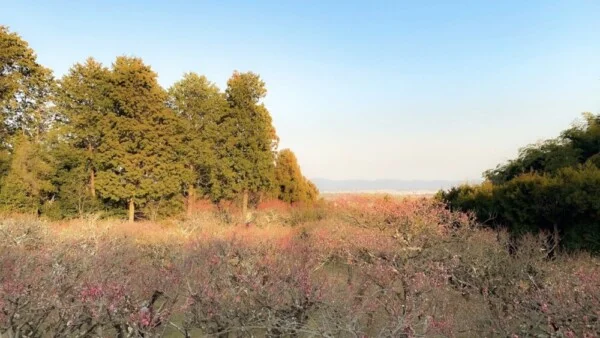
Some early trees usually start blooming from January, but the whole area reaches its best time after March begins.
Red and white plum blossoms bloom beautifully in full glory.
Visitor Information
- Hours: 9:00–17:00
- Admission: 300 yen
- Tel: 075-331-0105
- Address: 1102 Oharano Minami-Kasuga-cho, Nishikyo-ku, Kyoto
- Access: About a 10-minute walk from the Hankyu Bus stop “Minami-Kasuga-cho”
- Note: The plum grove is in the free area of the grounds (no restriction to enter).
Nagaoka Tenmangu Shrine (Nagaokakyo City) | Early to mid-March
The plum garden in Nagaoka Park has about 140 plum trees of 20 varieties
In Kyoto, when people talk about a Tenmangu shrine with name recognition second only to Kitano Tenmangu, Nagaoka Tenmangu often comes to mind.
It’s not as large as Kitano Tenmangu, but it is still one of Kyoto’s well-known plum blossom spots.
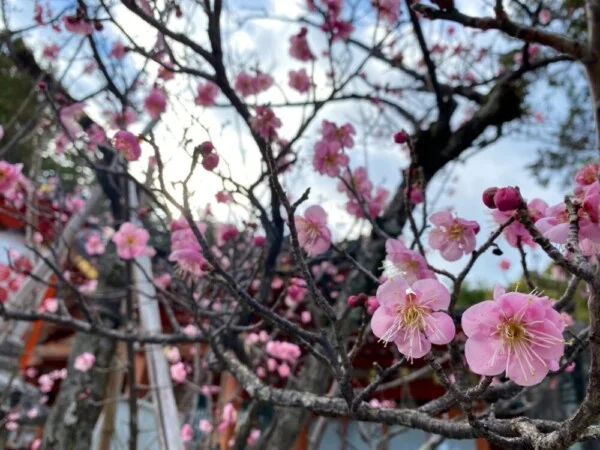
Next to Nagaoka Tenmangu, Nagaoka Park has a plum garden with about 140 trees of 20 varieties.
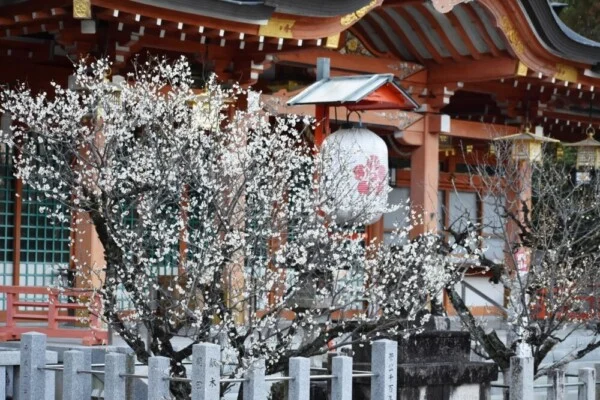
Not only in the plum garden of Nagaoka Park, but also around the grounds of Nagaoka Tenmangu, plum trees are planted in many places.
Especially, the plum trees in front of the main hall are called “Sakon no Koubai (red plum)” and “Ukon no Hakubai (white plum).”
In the past, in front of the Shishinden Hall at the Kyoto Imperial Palace, the trees planted were “Sakon no Ume (plum)” and “Ukon no Tachibana (mandarin orange).”
Visitor Information
- Hours: Daytime (any time)
- Admission: Free (grounds are open)
- Tel: 075-951-1025
- Address: 2-15-13 Tenjin, Nagaokakyo City
- Access: About a 10-minute walk from Hankyu “Nagaoka-Tenjin” Station
Conclusion
Throughout the year, plum blossoms are the next most popular after cherry blossoms and autumn leaves. However, compared with cherry blossoms and autumn leaves, there is not much information about plum blossoms.
But MK Taxi sightseeing drivers have a lot of knowledge about plum blossoms, too.
We introduced four places this time, but each driver also has their own personal recommendations.
They can guide you not only in Kyoto, but across the Kansai region as well. With an MK sightseeing charter taxi, you can enjoy Kyoto’s plum blossoms to the fullest.
Why not try a different kind of Kyoto trip with a professional guide and driver?
For sightseeing in Kyoto, leave it to MK’s chartered sightseeing taxi.
Your private driver is a Kyoto expert who handles both transport and guiding.
