
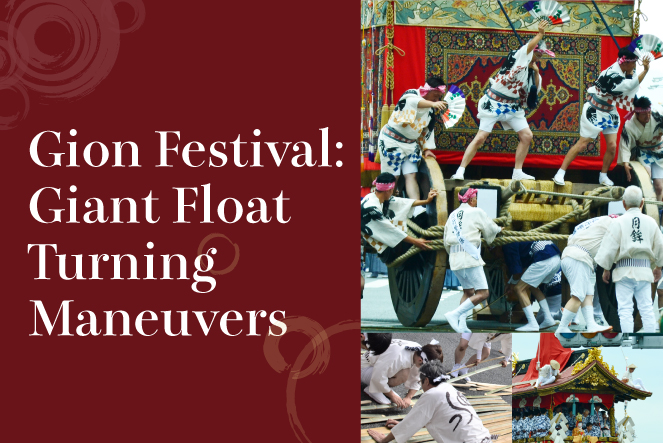
Gion Festival: Giant Float Turning Maneuvers
When people talk about the 31-day Gion Festival, the biggest highlight is the Yamahoko Procession. Among its many attractions, the most impressive is the “turning maneuver.”
This dramatic technique allows a massive float weighing over 10 tons to make a 90-degree turn at an intersection.
How can a float with no steering wheel change direction? Let’s take a closer look at the fascinating turning maneuver.
Shimenawa Rope-Cutting Ceremony at Shijo Fuyacho
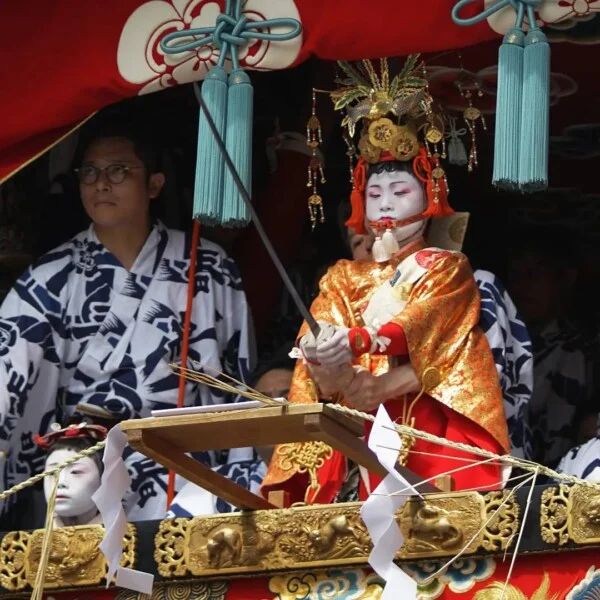
The Gion Festival Yamahoko Procession begins at 9:00 a.m.
At exactly 9:00 a.m., the Naginata Float, which always leads the procession without taking part in the lottery draw, starts moving from Shijo Karasuma.
The long blade mounted on top of the float is believed to ward off epidemics and evil spirits.
At around 9:20 a.m., the Shimenawa Rope-Cutting Ceremony takes place at Shijo Fuyacho. During this ceremony, the Naginata Float cuts a sacred rope stretched across the street, marking the official start of the procession.
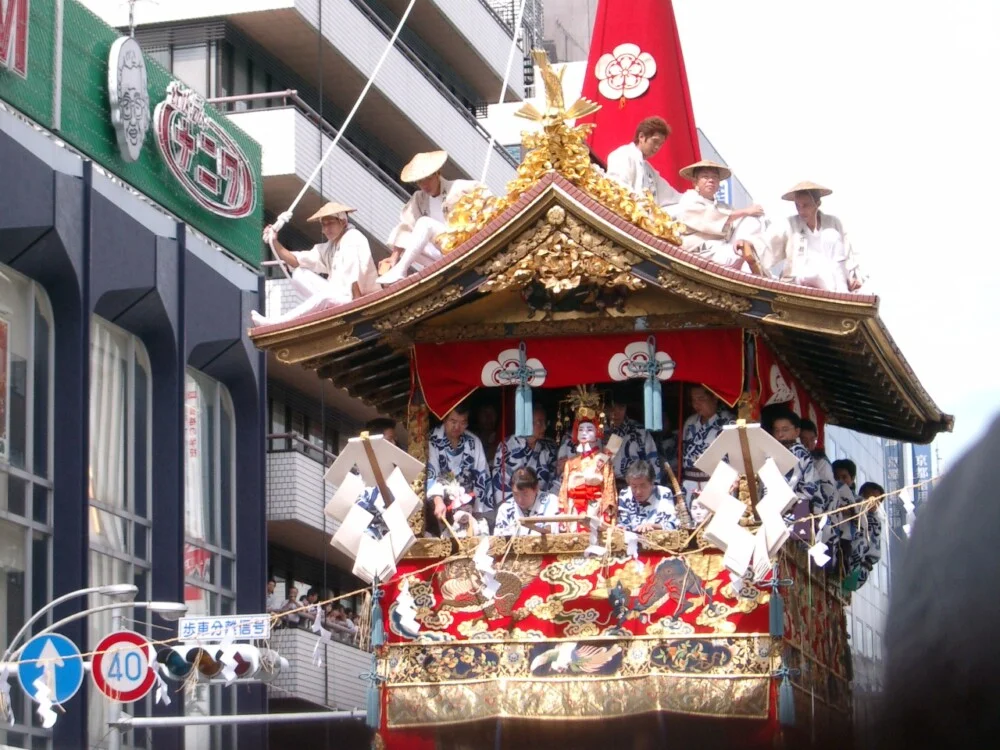
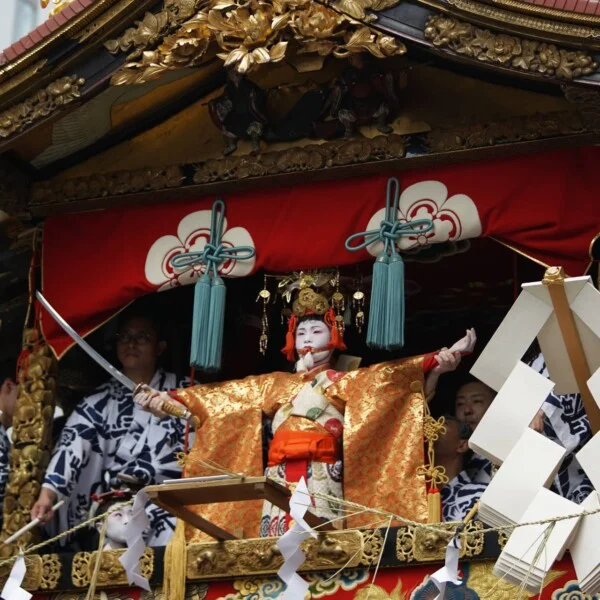
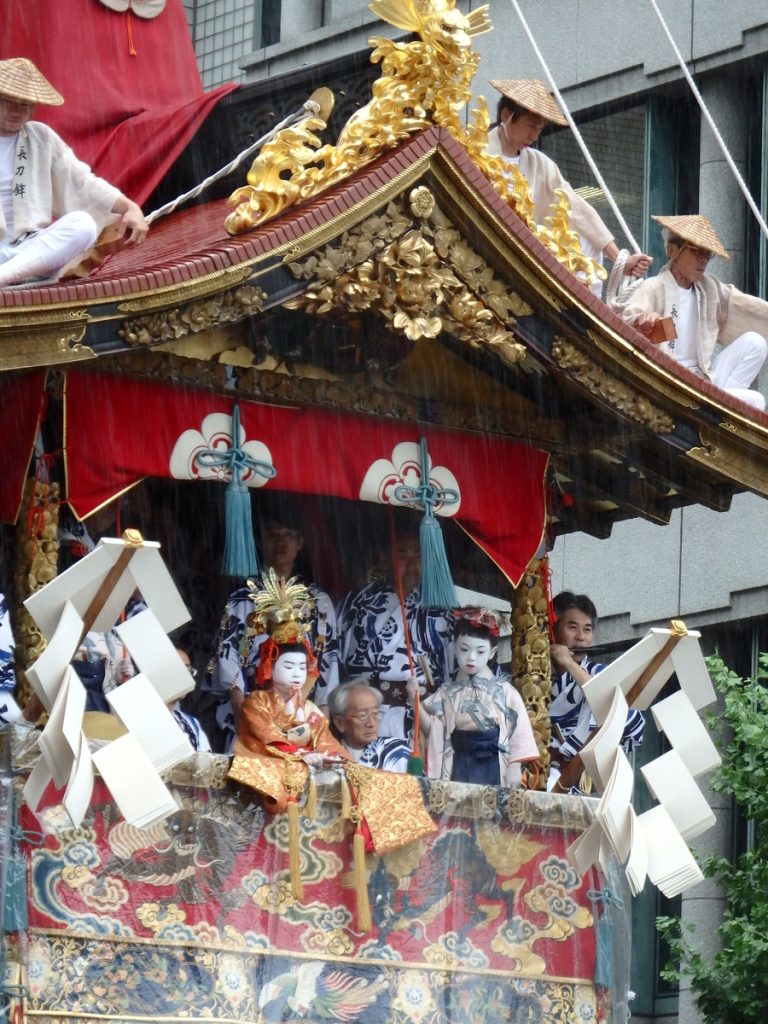
In the past, every float carried a chigo (sacred child). Today, only the Naginata Float continues this tradition. On the other floats, the chigo have been replaced by dolls.
The Turning Maneuver in the Yamahoko Procession
What Is the Turning Maneuver?
The turning maneuver refers to the way Yamahoko floats—more specifically, hoko, funeboko, and hikiyama floats—make right or left turns during the procession.
Unlike a car, the wheels of these floats cannot be steered. Because they must support a massive weight of more than 10 tons, the wheels are not built with a turning mechanism.
The floats change direction by being pulled from the side, causing them to pivot around their wheels and rotate into a new direction.
The turning maneuver of these massive floats, weighing more than 10 tons, is the climax of the Yamahoko Procession and one of its most spectacular sights.
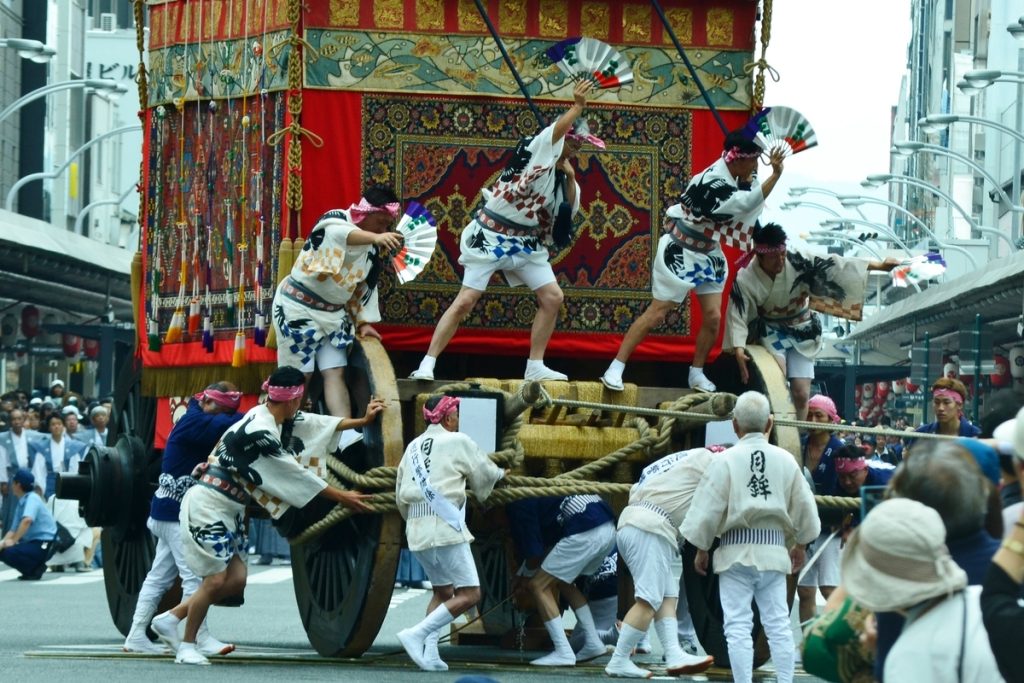
Water is poured over split bamboo, and the hoko float is turned while sliding over it.
The rear wheels of the float are about 60 cm smaller than the front wheels. This makes the center of gravity rest on the rear wheels, so the float can turn more easily.
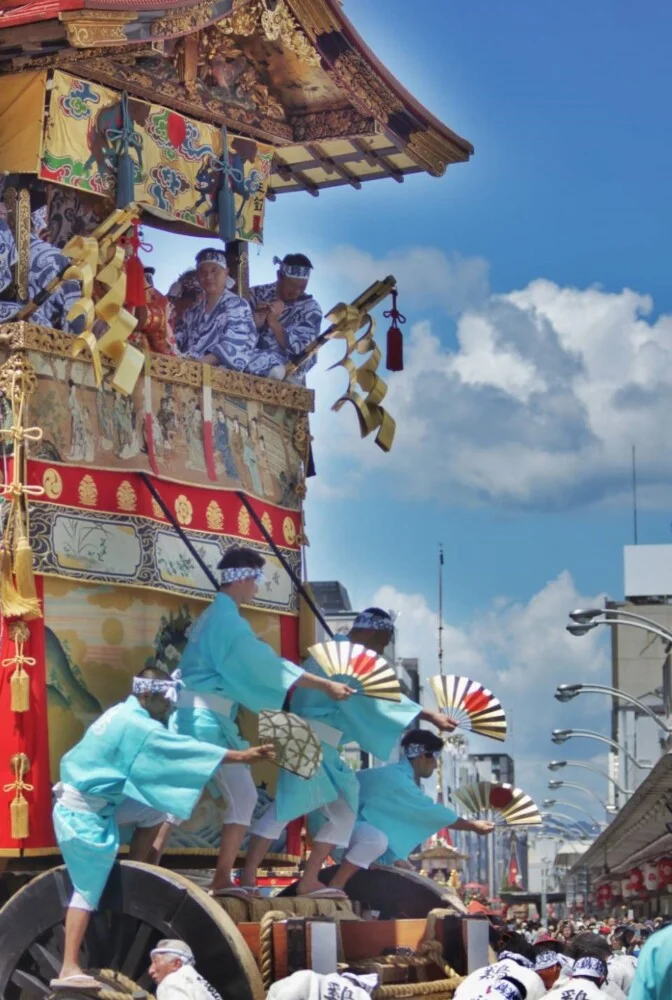
The key figure in the tsujimawashi is the wheel handler. The wheel handler is the driver responsible for steering the hoko float.
Tsujimawashi is the moment when the wheel handler’s skill is put on display. Even highly experienced veteran wheel handlers feel nervous when performing a tsujimawashi.
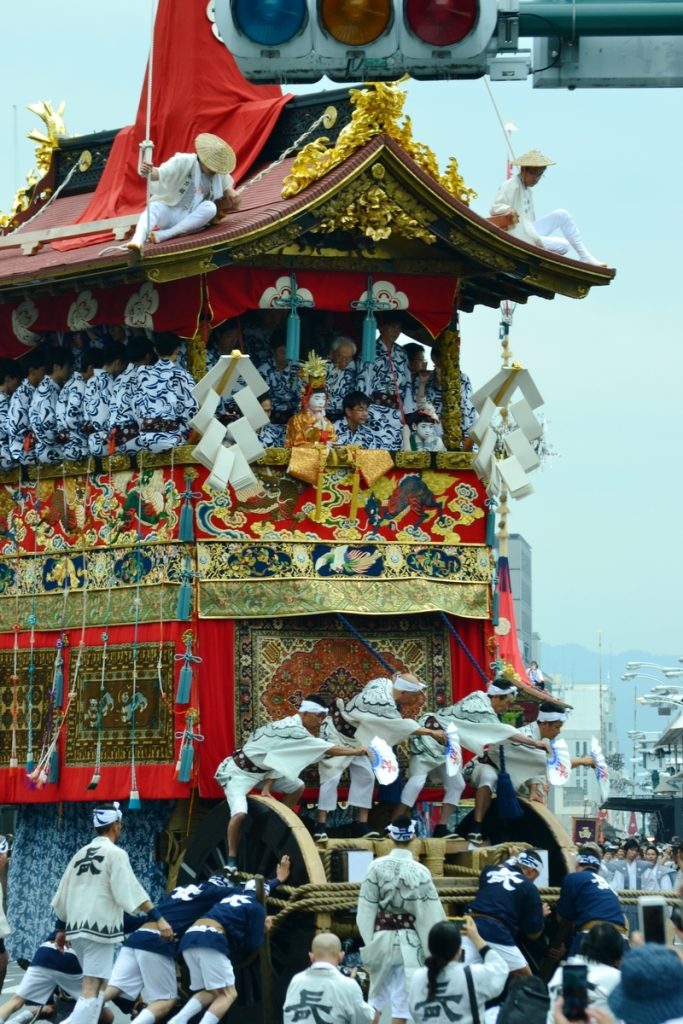
During the Yamahoko Procession, tsujimawashi takes place at three locations during the Former Festival: Shijo Kawaramachi, Kawaramachi Oike, and Shinmachi Oike.
In addition, all floats except Naginata Hoko, Kanko Hoko, and Tsuki Hoko, which travel along Shijo Street, perform tsujimawashi when entering or leaving Shijo Street.
At every tsujimawashi viewing spot, spectators begin reserving places early in the morning.
As all of these locations become extremely crowded, it is recommended to decide where you want to watch and arrive at least one hour in advance.
Some people who are serious about photographing tsujimawashi even arrive before dawn to get ready.
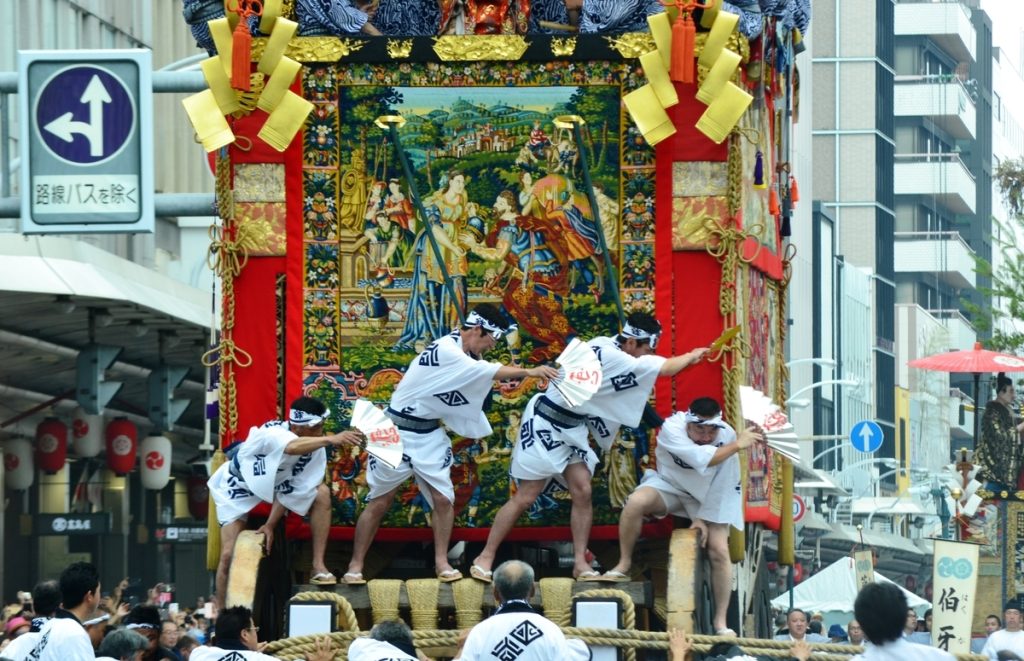
Steps of Tsujimawashi
Laying down split bamboo strips
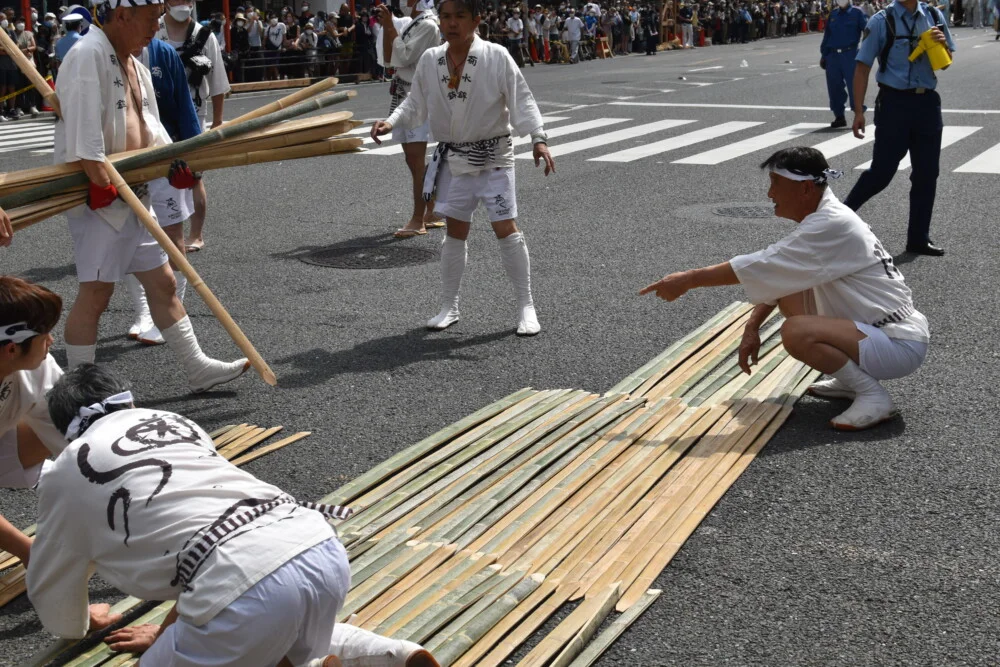
Before the float arrives, split bamboo strips are laid down at the spot where the tsujimawashi will take place.
These bamboo strips act as a lubricant, allowing the float to slide across them.
One of the keys to a successful tsujimawashi is laying the bamboo neatly and tightly without gaps.
After the bamboo is in place, water is poured over it to make the surface even more slippery.
It is said that in the past, fresh cherry wood was sometimes used instead of split bamboo for tsujimawashi.
Placing the front wheels onto the split bamboo strips.
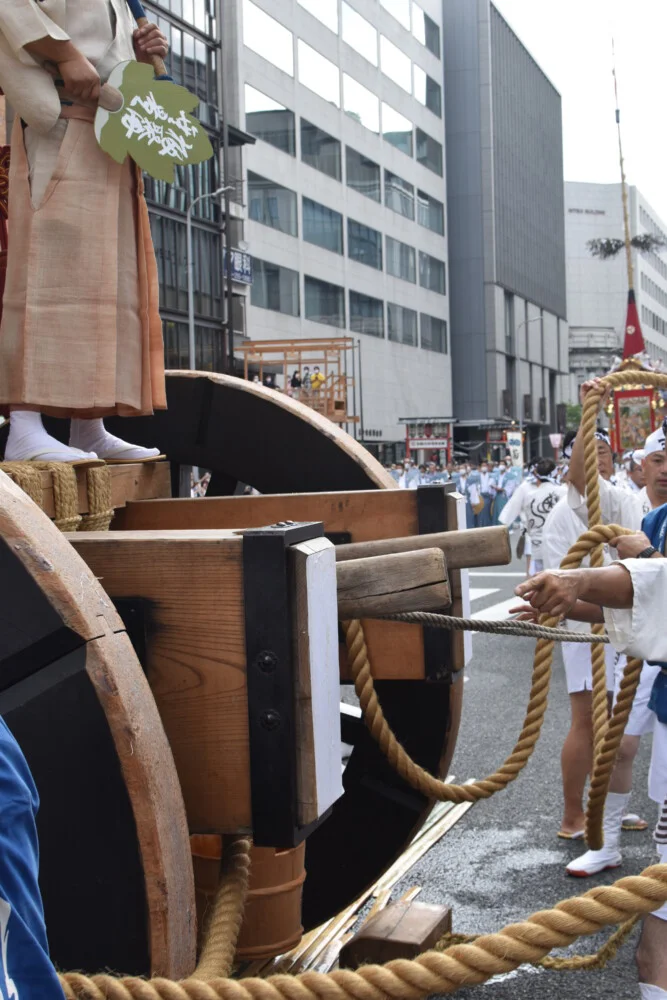
To perform a tsujimawashi, the float stops precisely with its front wheels positioned on the split bamboo strips.
To stop the float, a trapezoid-shaped wheel chock is pushed against the wheels.
The float has ropes attached not only at the front but also at the rear. By pulling the rear ropes in the opposite direction, the float can be braked.
The split bamboo used for tsujimawashi is laid at a right angle to the float’s direction of travel.
During the turn, the wheels slide sideways along the bamboo strips.
Repositioning the pulling ropes
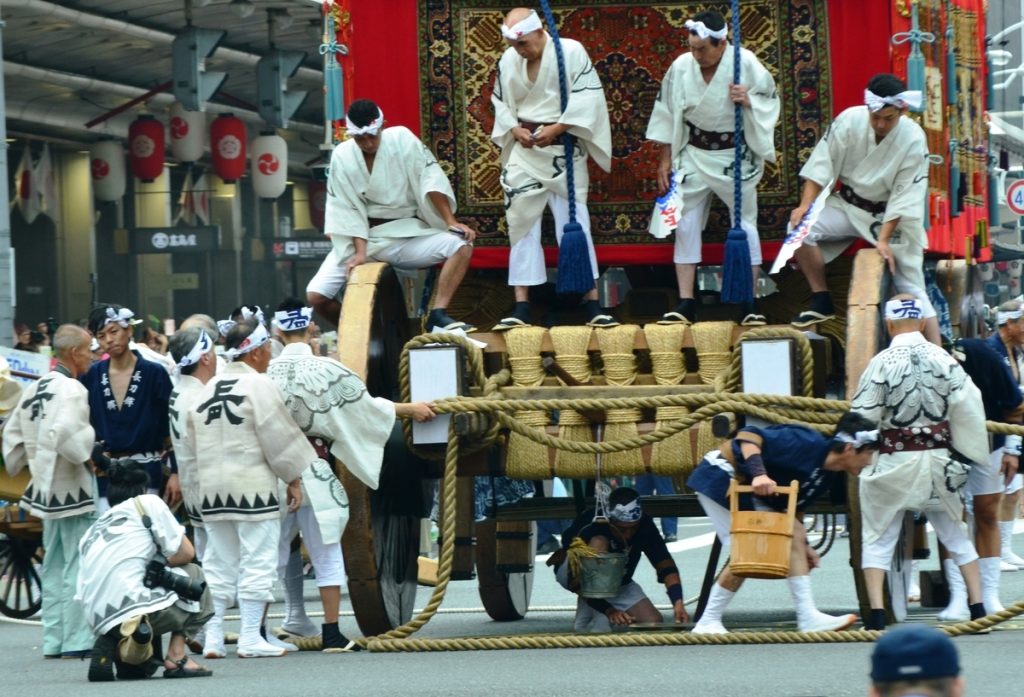
The rope pullers change direction by 90 degrees and line up along the left side of the float.
The point where the rope is attached also changes. During normal forward movement, the rope is tied to the stone weight, but during tsujimawashi it is attached to the front axle.
Volunteers are also recruited to serve as rope pullers for the floats. Since this is a sacred ritual, participation is limited to men, but members of the public can join if they meet the requirements.
Although their main role is to pull the ropes, they also get an excellent close-up view of the float’s tsujimawashi, making it a highly recommended experience.
Pulling in unison with the signal
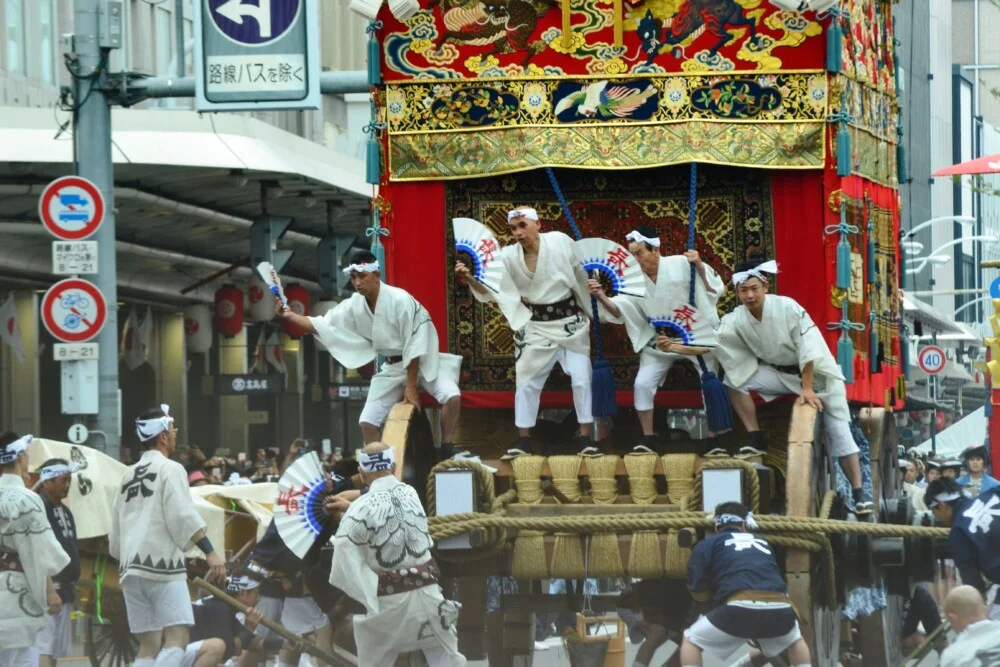
Once the preparations for tsujimawashi are complete, the lead callers give the signal by shouting “Enyaraya,” and the float is pulled sideways in unison.
The moment when the enormous float creaks and slowly turns is the climax of the Yamahoko Procession and one of its most impressive sights.
There are usually two lead callers, but during tsujimawashi the number is often increased to four.
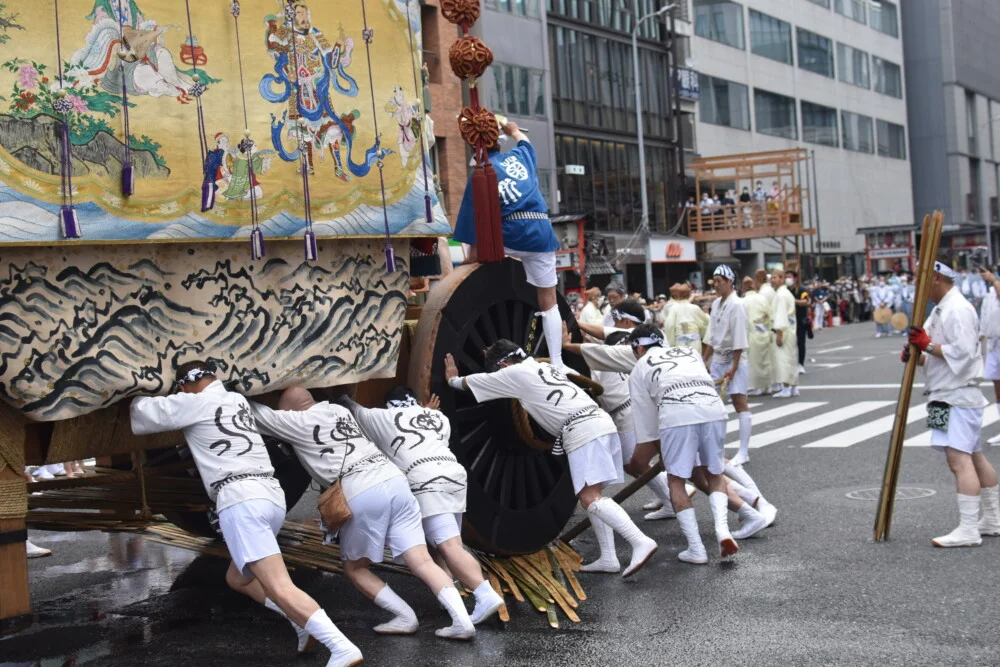
At the moment of tsujimawashi, most attention is focused on the side pulling the ropes, but there are also people on the opposite side whose job is to push the float.
They push the massive float either with their hands or with the help of lever bars.
By applying balanced force from both sides, the float can be turned safely and efficiently.
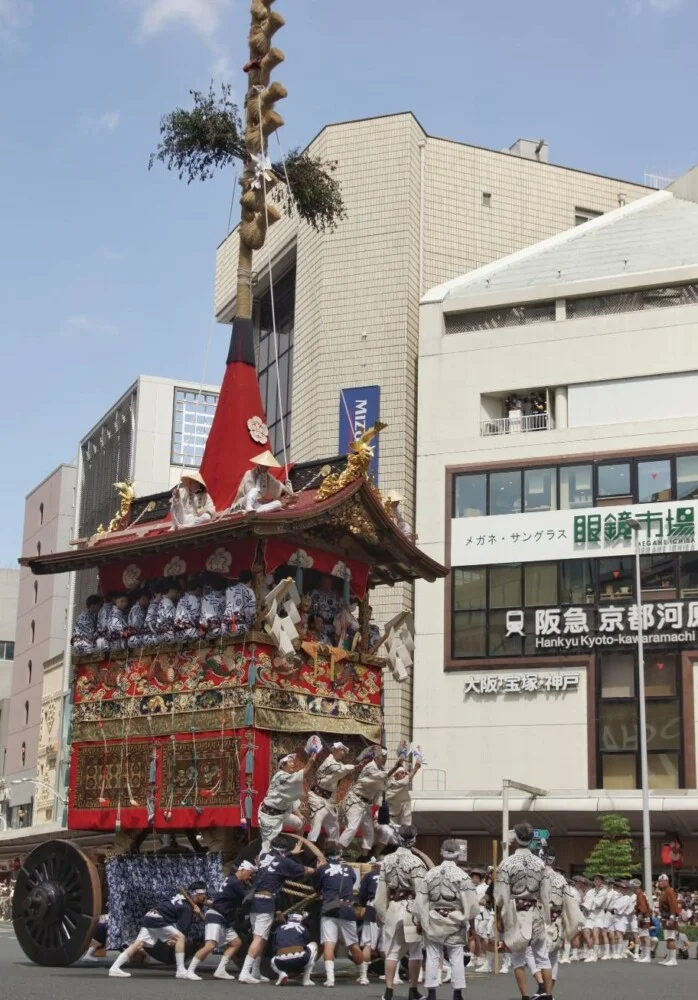
Tsujimawashi is usually performed three to four times. For this reason, turning the float by about 30 degrees each time is considered ideal. Turning more than 30 degrees increases the risk of the float tipping over.
Depending on the situation, more than five turns may be needed, including the final fine adjustments.
When the tsujimawashi is completed successfully, the spectators along the route often respond with enthusiastic applause.
It is truly impressive that a massive float weighing more than ten tons can be turned using human power alone.
Before roads were paved, people did not use split bamboo as they do today. Instead, they used oak wood as levers and turned the float little by little in smaller increments.
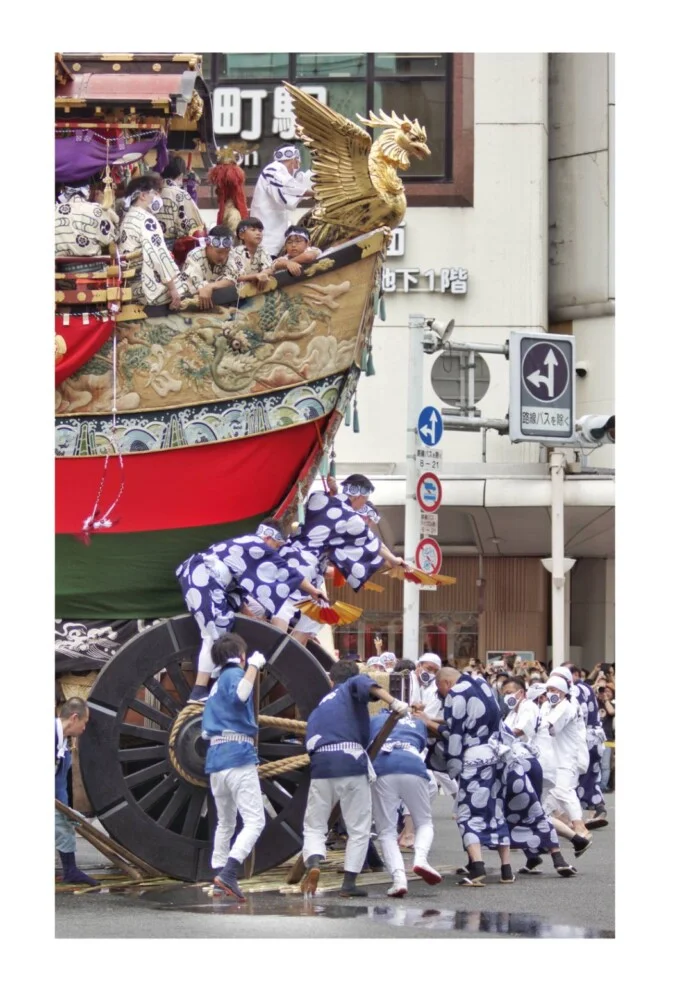
In addition to the hoko floats, tsujimawashi is also performed by Fune Hoko and the hikiyama floats.
Kakiyama floats, however, are traditionally carried by people. Since they can be lifted and turned directly, they do not perform tsujimawashi.
Relaying the split bamboo strips
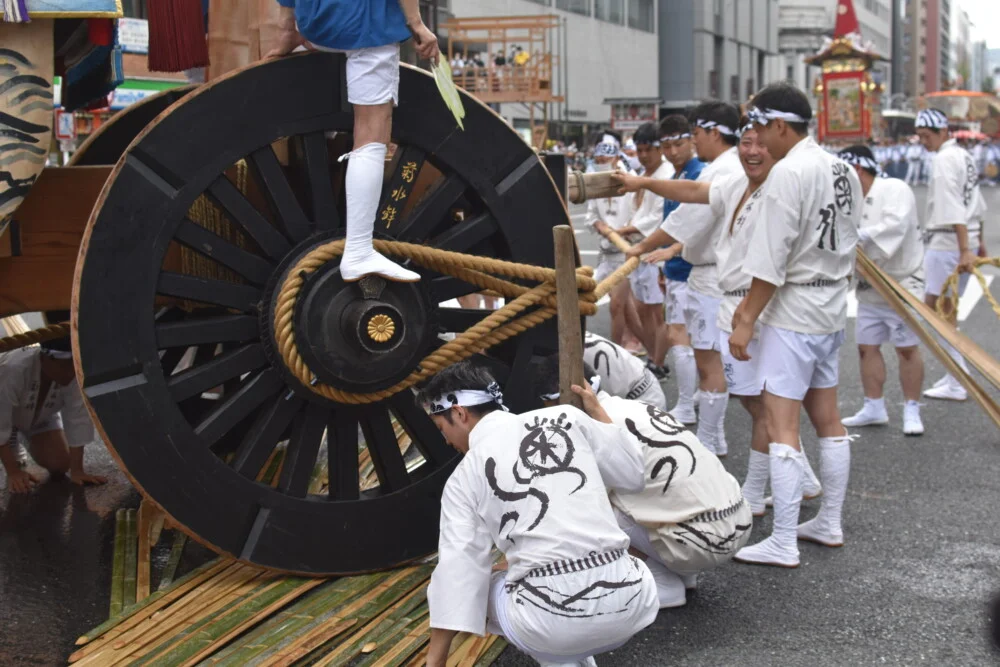
Each time the float turns during tsujimawashi, the split bamboo strips must be laid again.
The bamboo that has moved to the outside of the front wheels is repositioned to the inside, preparing for the next turn.
Cleaning up afterward
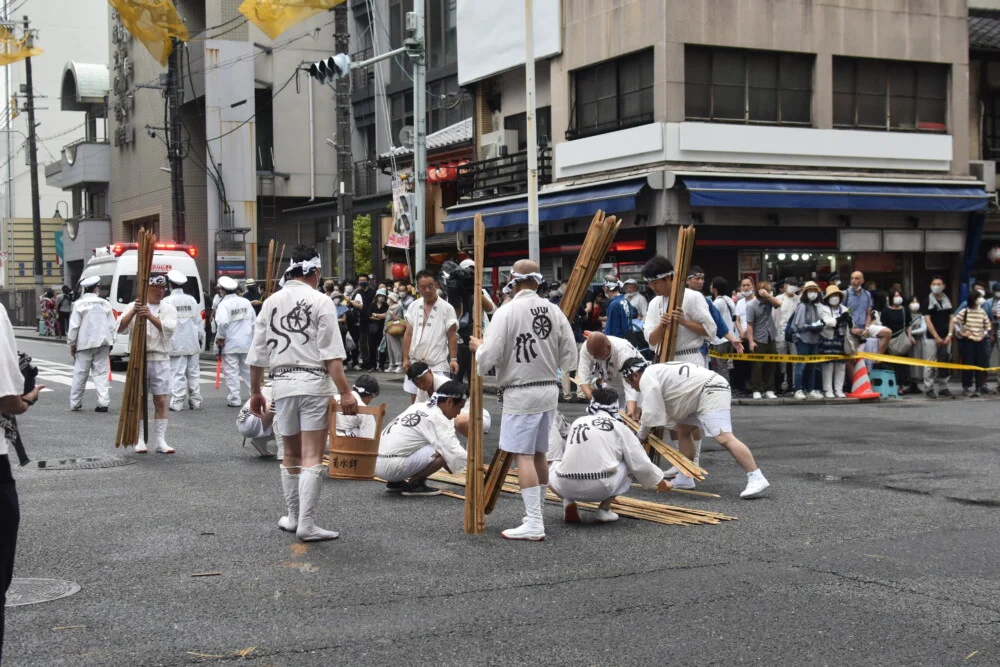
After the tsujimawashi is finished, the remaining split bamboo strips and other materials are cleaned up and collected.
The bundled bamboo strips are then stored in the storage space underneath the float.
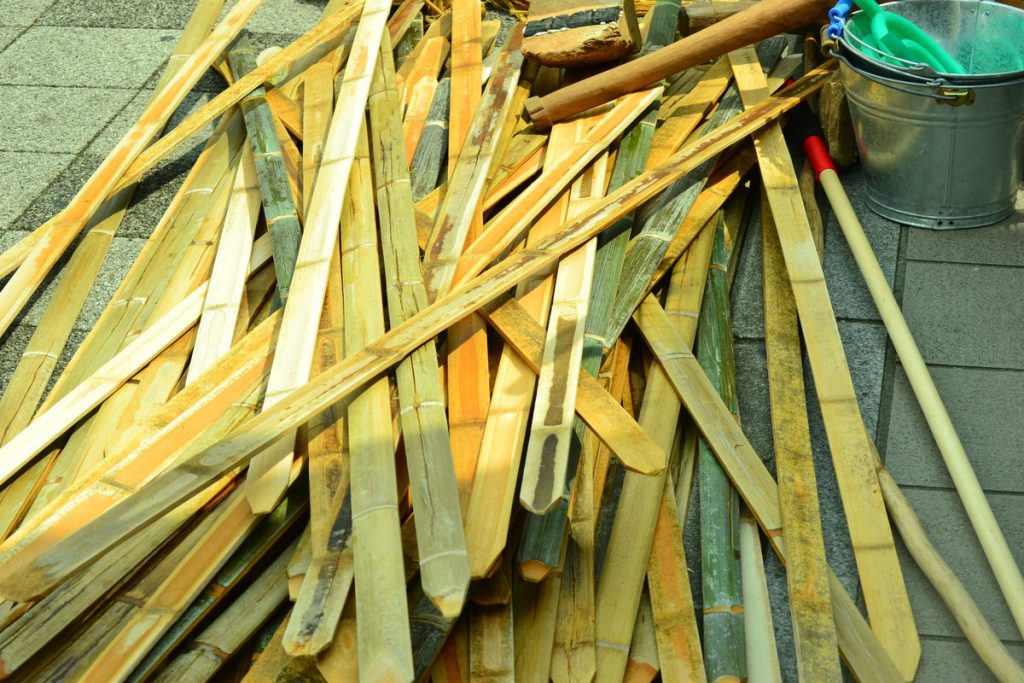
This shows the condition of the split bamboo strips after they were used in a tsujimawashi to turn a float by 90 degrees.
Water is poured onto the bamboo, and the massive float is then rotated while sliding across its surface.
Because the float weighs more than ten tons, the bamboo is subjected to tremendous pressure, leaving cracks in many places.
Various Information About the Gion Festival Yamahoko Procession
Preparations for the Yamahoko Procession
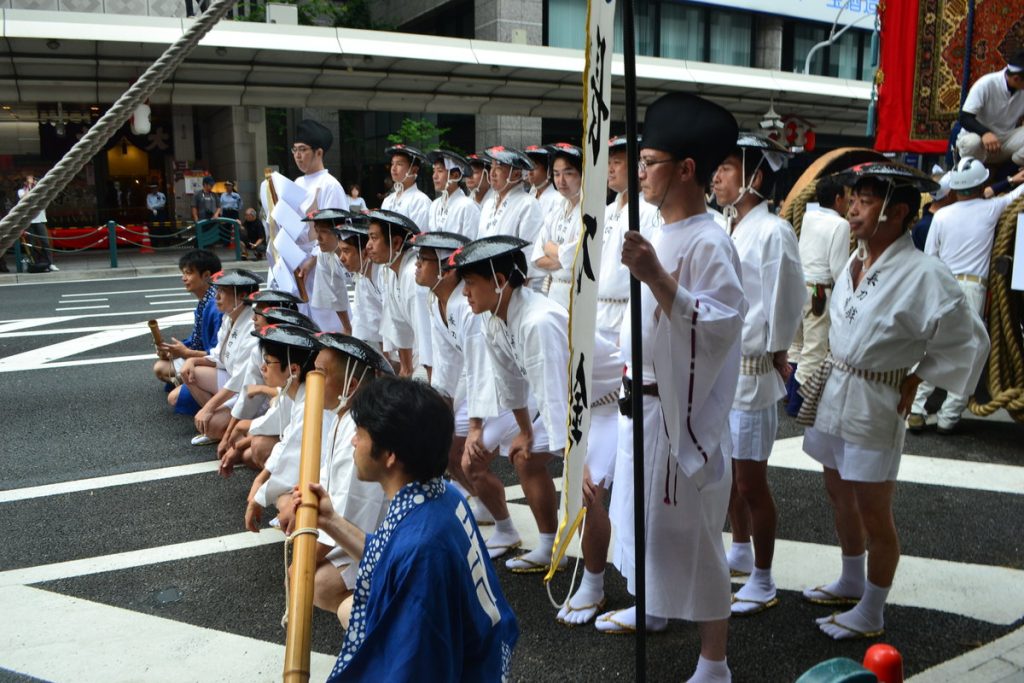
In front of the Naginata Hoko, volunteer pullers taking part in the Yamahoko Procession gather for a group photo.
In the past, the population of the Yamahoko neighborhoods declined, leading to a shortage of pullers. As a result, university students working part-time were recruited to fill this role during the procession.
In recent years, volunteers, mainly students from Kyoto, have taken on the role of pulling the floats in the Yamahoko Procession.
For students who come to Kyoto from all over Japan, being able to participate in the Gion Festival’s Yamahoko Procession becomes a wonderful memory.
Not only do they get to take part in the Gion Festival, but they can also watch the procession from up close.
It is truly the best seat in the house for the Yamahoko Procession. An experience like this is unlikely to come again in a lifetime.
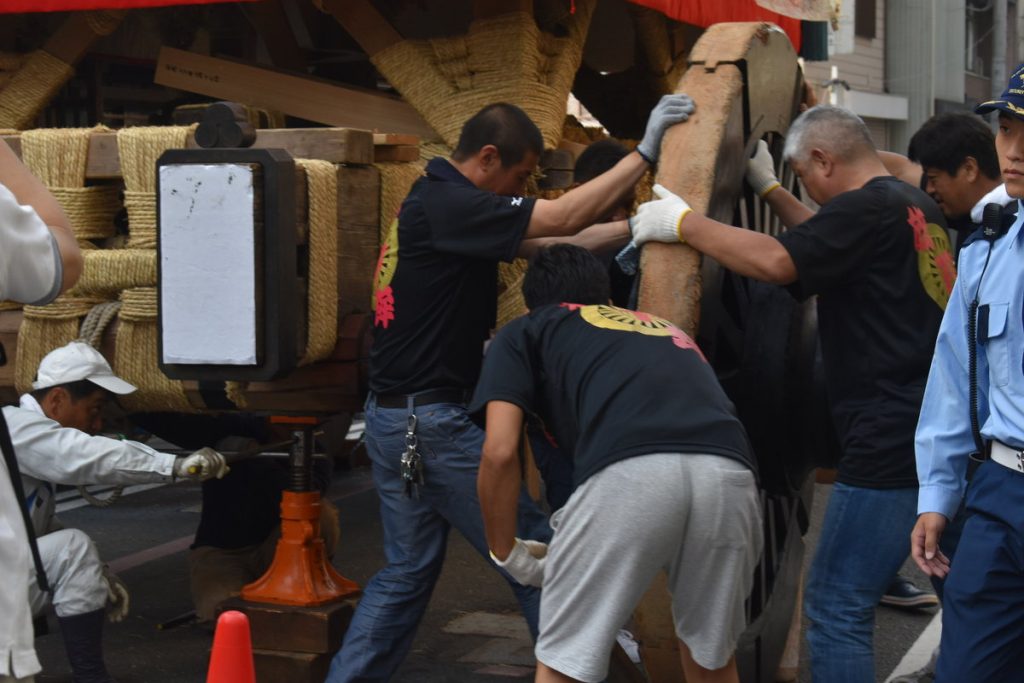
Before the Yamahoko Procession begins, a final inspection of the wheels and other components is essential.
Even though a trial pull has already been carried out, further adjustments may still be needed.
Since any malfunction could be dangerous, jacks are used to support the weight of the float, and the wheels are temporarily removed and reinstalled.
This is one part of the preparation where extra caution is necessary.
In fact, there have been accidents in which festival floats tipped over.
Although it did not happen during the procession itself, at the 1951 Gion Festival the Tsuki Hoko overturned while its wheels were being installed. As a result, it was unable to take part in the Yamahoko Procession that year.
It also appears that before 1951, accidents involving overturned floats occurred from time to time during activities related to the procession.
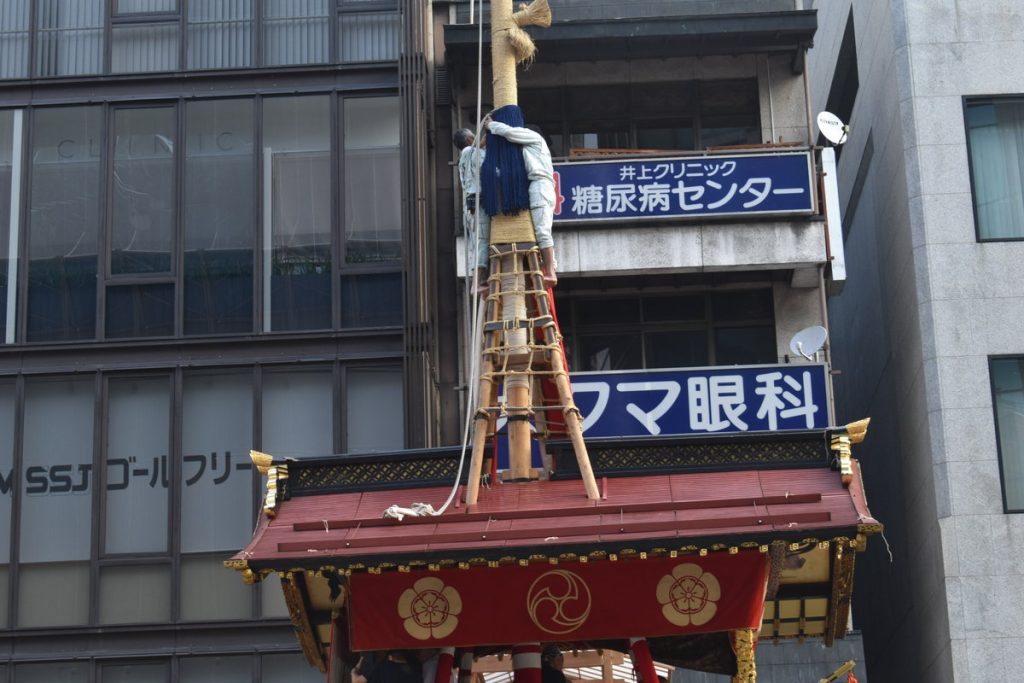
Preparations for the Yamahoko Procession take place not only around the wheels and undercarriage, but also on top of the float.
The red decorative netting that had already been attached is temporarily removed and then carefully adjusted and reinstalled.
Even just watching this work is frightening, as it is carried out at a great height without any safety ropes.
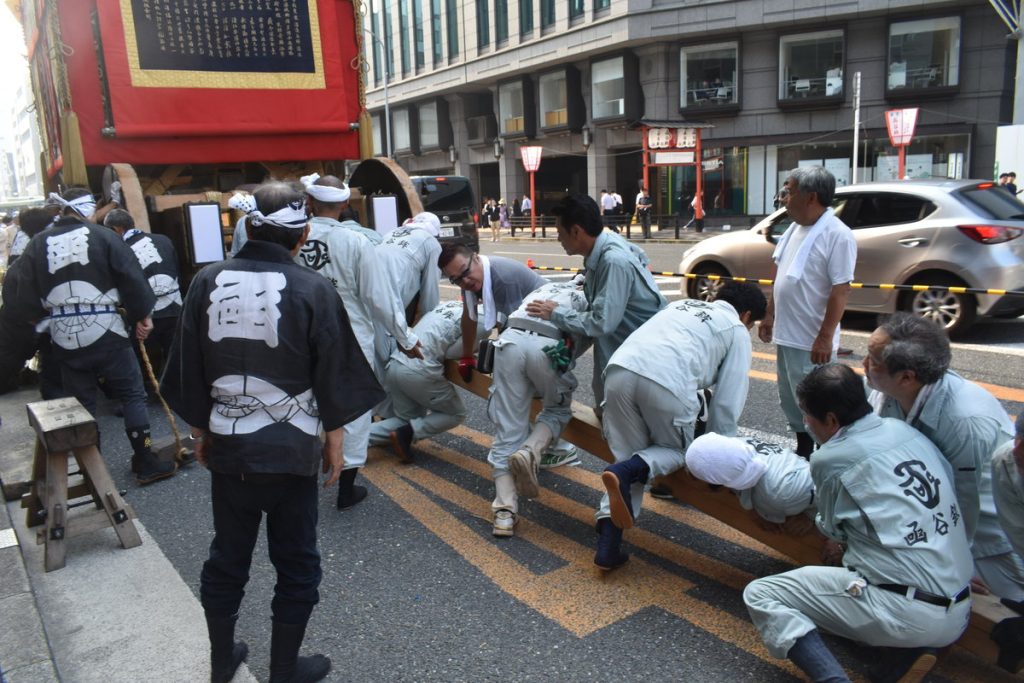
Once all preparations for the Yamahoko Procession are complete, the final step is to remove the wheel chocks.
Using large wooden beams and the principle of leverage, the workers lift the hoko slightly and remove the chocks during that brief moment.
The massive float, weighing nearly 10 tons, rises just a little off the ground.
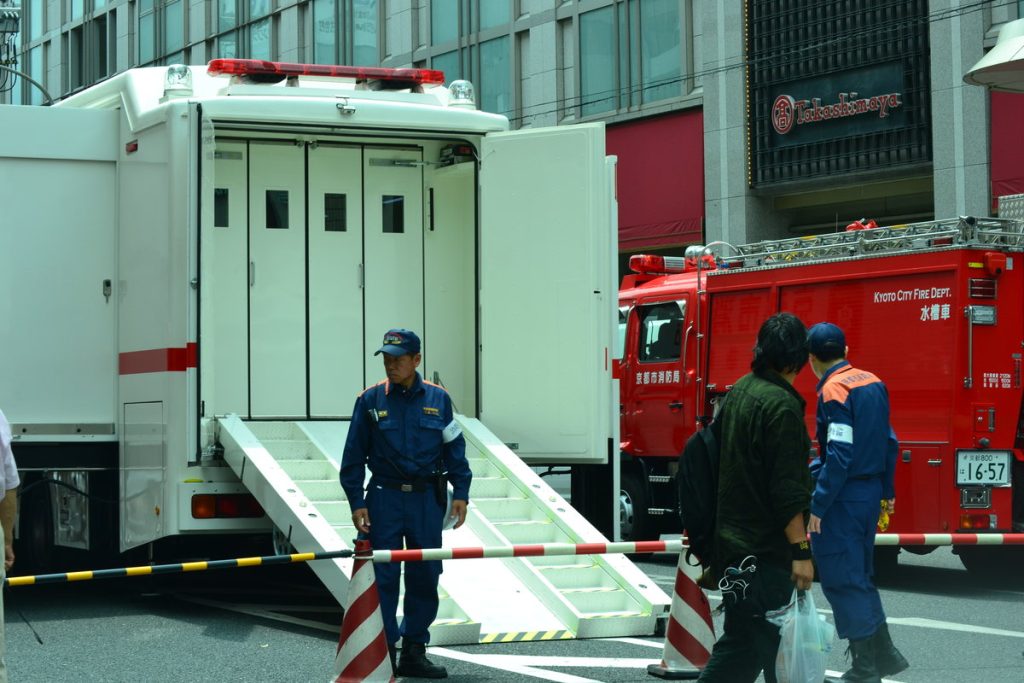
At Shijo Kawaramachi, a mobile first-aid station operated by the Kyoto City Fire Department is also on standby.
Because of the increasingly intense summer heat in recent years, temperatures often exceed 35°C even during the time of the Yamahoko Procession.
Depending on the weather conditions, there is a real possibility that spectators could collapse from heatstroke one after another.
Scenes from the Yamahoko Procession
Reasons Why the Yamahoko Procession Is Cancelled
Cancelled in 2020 and 2021 Due to COVID-19
The Yamahoko Procession is not easily cancelled by ordinary circumstances.
In 2015, the procession was held even though a typhoon struck the area directly.
Since the interruption caused by the Ōnin War, the only times the procession had been cancelled were from 1943 to 1946 during World War II, and in 1962 due to the underground line extension project of Keihanshin Express Railway (now Hankyu Railway). For this reason, the cancellation of the Yamahoko Procession in 2020 and 2021 because of the COVID-19 pandemic will likely continue to be remembered and discussed as a major event in the long history of the Gion Festival.
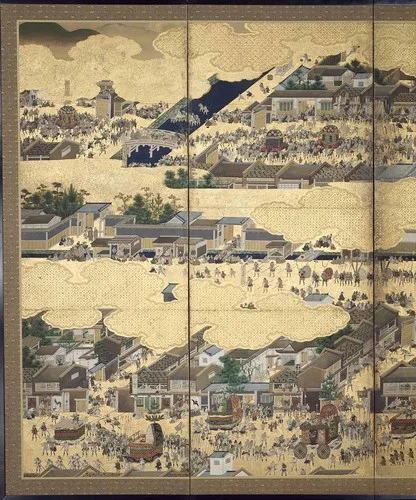
Cancelled in 1962 Due to the Hankyu Extension Project
Unlike cancellations caused by war or epidemics, the reason for the cancellation of the Yamahoko Procession in 1962 was quite unusual.
What is now the Hankyu Kyoto Line originally opened in 1928 as the Shinkeihan Railway, operating between Tenjinbashi (now Tenjimbashisuji Rokuchome) and Kyoto Saiin. In 1933, the line was extended to Omiya Station.
After the Ato-matsuri Yamahoko Procession on July 24, construction began on August 1, 1961, to extend the line to Kawaramachi Station, a long-awaited project.
At the time, underground railway construction commonly used the open-cut method.
During the 1962 Gion Festival season, construction was at its peak. Excavated sections of the road were covered with steel plates.
Even so, efforts were made to see whether the procession could still be held. Late on the night of May 27, the Tsuki Hoko was erected on Shijo Street, and a test pull was conducted with a total weight of approximately 14 tons.
The tests showed that the steel plates were strong enough to support the weight. However, rivets on the plates damaged the wheels of the float.
Because it was impossible to rule out unexpected accidents, the Yamahoko Federation decided at its general meeting on June 13 to cancel that year’s procession.
As a result, although the festival floats—except for Kanko Hoko—were still assembled during the 1962 Gion Festival, they were not paraded. Instead, the festival was held in the form of an I-matsuri, where the floats remained on display without procession.
After a difficult construction project, the extension of the Hankyu Kyoto Line to Kawaramachi Station was completed, and the new section opened on June 17, 1963.
A similar issue later arose during construction of the Kyoto Municipal Subway Tozai Line beneath Oike Street. However, thanks to advances in construction methods, the Yamahoko Procession was able to proceed as usual.
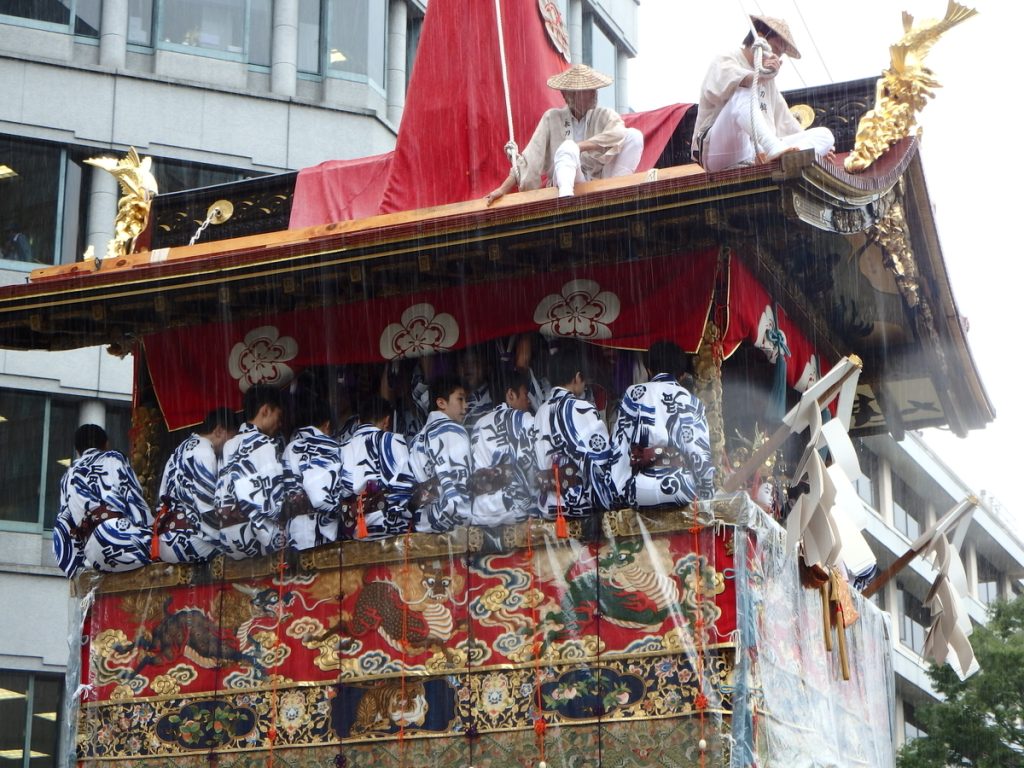
During the 2015 Yamahoko Procession, which took place while a typhoon was approaching, the roof attendants (yanekata) were required to wear safety lines while working on top of the floats.
As a result, the procession was completed safely without any accidents, even under direct typhoon conditions.
In fact, fall-related accidents have occurred in the past. For example, in 1965, there was an accident involving a person falling from the Naginata Hoko.
An even more tragic incident occurred in 1808 (Bunka 5), when a child performing as a festival musician on the Tsuki Hoko fell from the float and was run over, resulting in immediate death.
There was also a fatal accident in 1872 that did not involve a fall. After the Yamahoko Procession had ended, a boy was struck and killed by the Kanko Hoko near the Karasuma-Bukkōji area.
More than 150 years later, the Kanko Hoko Preservation Society still visits the boy’s grave at Ryugenji Temple in Utano every year in early July before the procession.
Through this annual memorial visit, they reaffirm the importance of safety and pray for a safe and successful Yamahoko Procession each year.
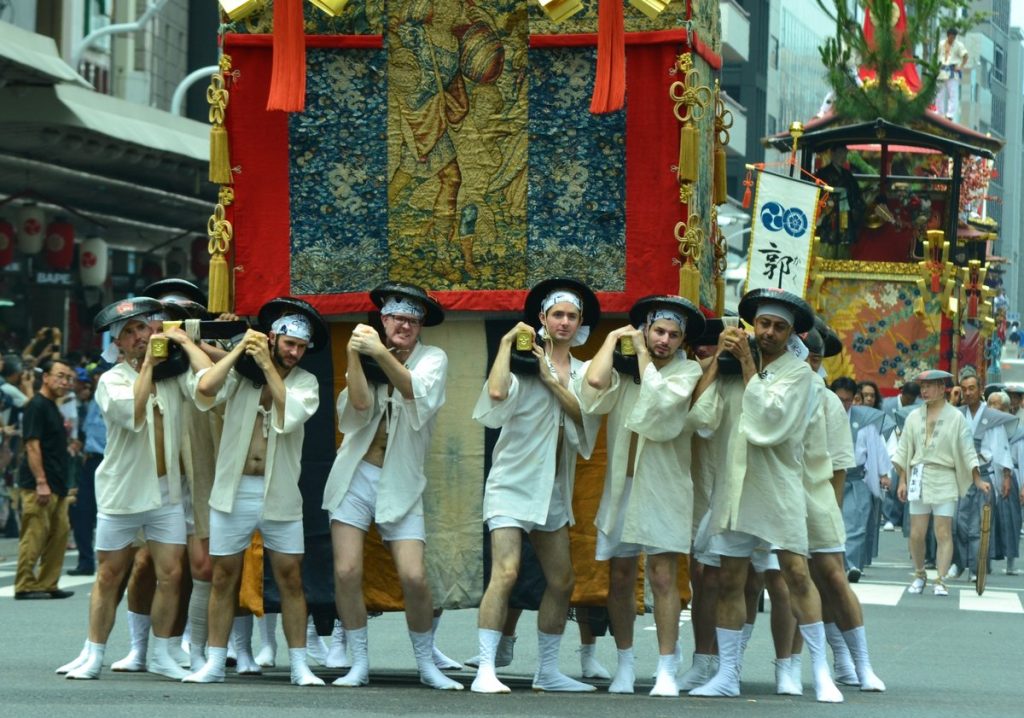
Foreigners also take part as float carriers
The carriers of the Haku Rakuten Yama are mainly made up of international participants.
Many of them are exchange students and international students who have come to Japan from various countries, and they help carry the festival float during the procession. The group even includes staff members responsible for foreign-language training at MK Taxi.
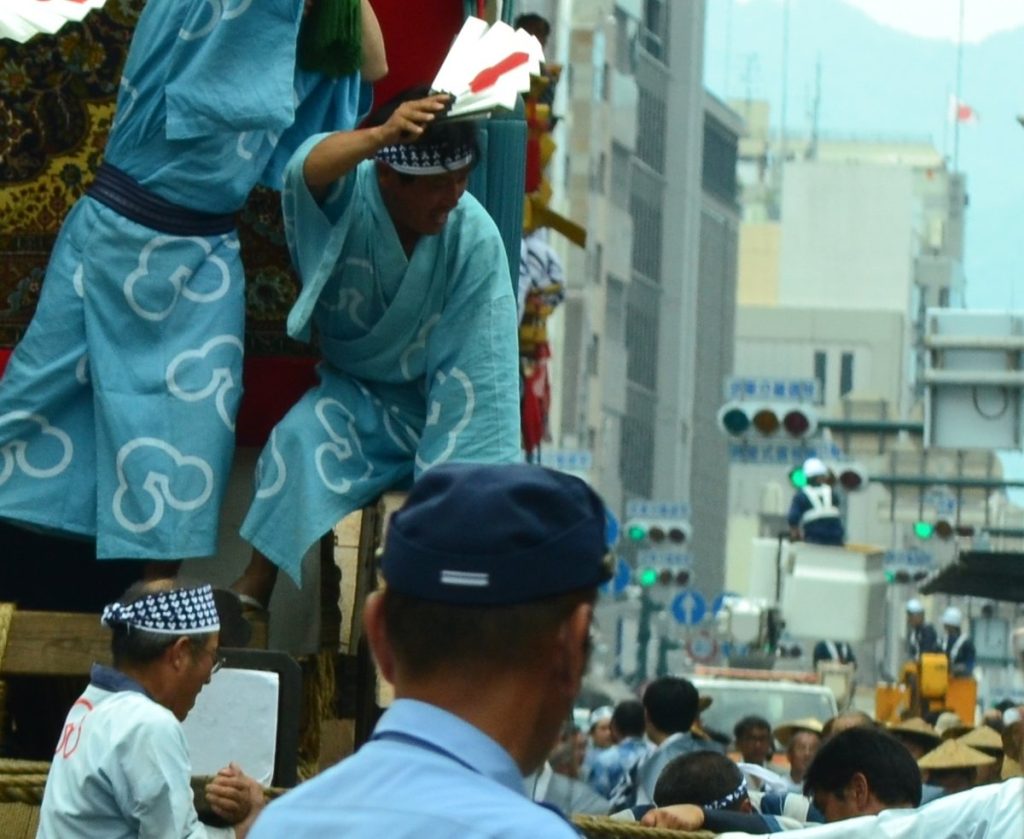
As soon as the Yamahoko Procession ends, traffic restrictions are lifted immediately.
As can be seen from the fact that the traffic signal behind the float on Shijo Street has already turned green, the aerial work vehicles waiting nearby are ready to move in. This shows how quickly the restrictions are removed once the procession is over.
Kyoto hosts not only traditional events such as the Yamahoko Procession but also many long-distance relay races. As a result, the city has extensive experience in managing and lifting traffic restrictions efficiently.
The Wheels and Ropes After the Yamahoko Procession
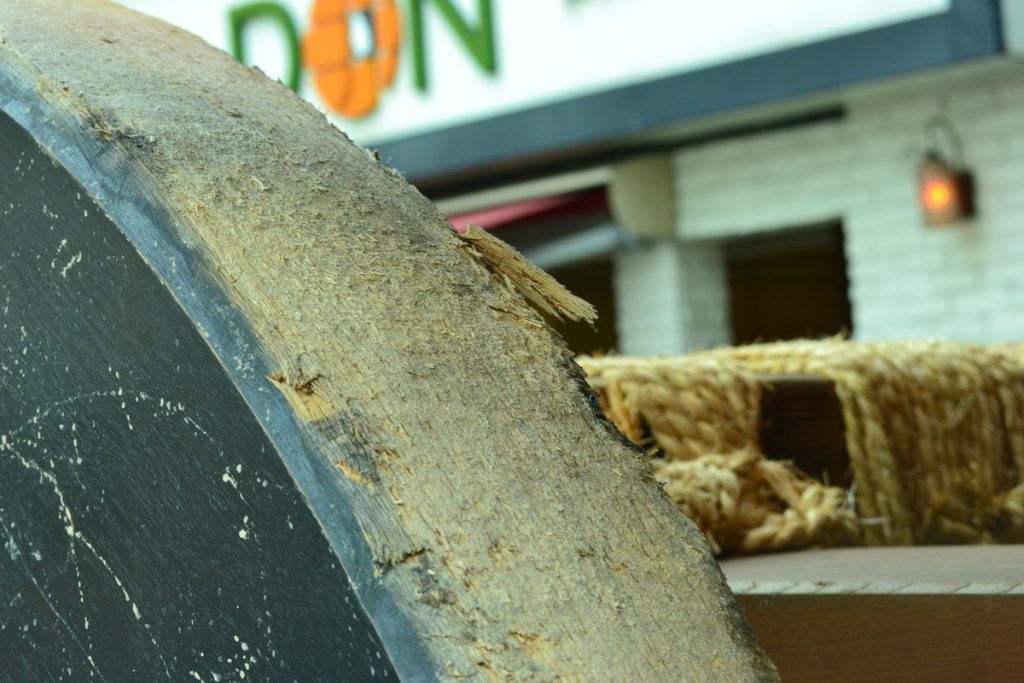
These are the rough, splintered wheels of the Tsuki Hoko float after the Yamahoko parade.
The wheels are maintained every year and used again and again. The large wooden pieces around the outer edge are partly replaced over time, so they can be used for many years. Even replacing only these outer pieces can greatly change how the wheel behaves.
People say the wheels last about 50 to 100 years, but their lifespan seems to be getting shorter because of asphalt roads.
The wheels are made from hard woods such as white oak, red oak, ubame oak, and zelkova.
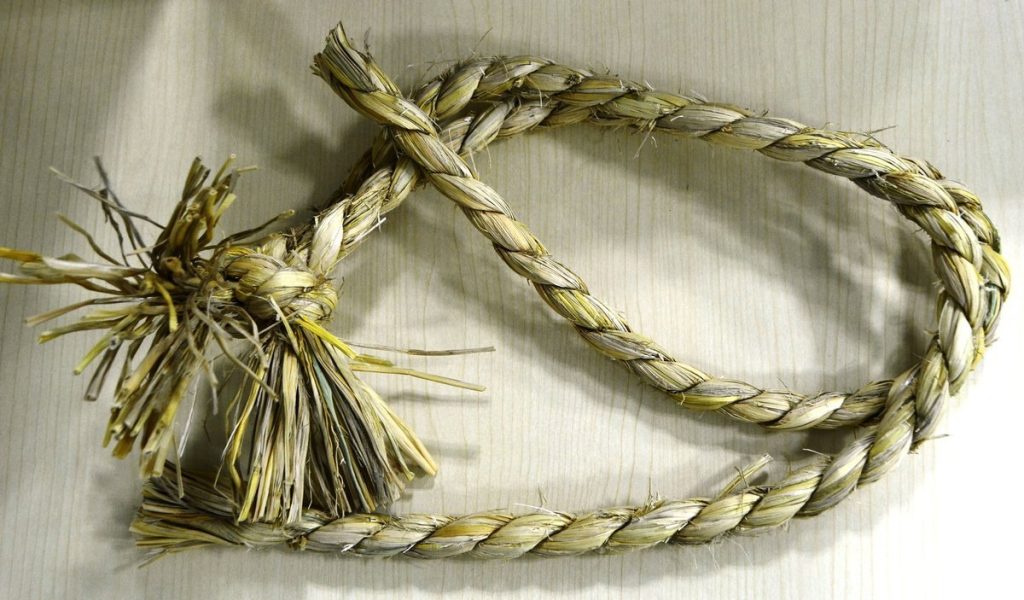
The ropes used on the Yamahoko floats are believed to bring protection from bad luck.
The day after the Yamahoko parade, I asked at the Naginata Hoko float while it was being dismantled and received a small piece of rope. The staff will say, “You can take it,” so feel free to ask them.
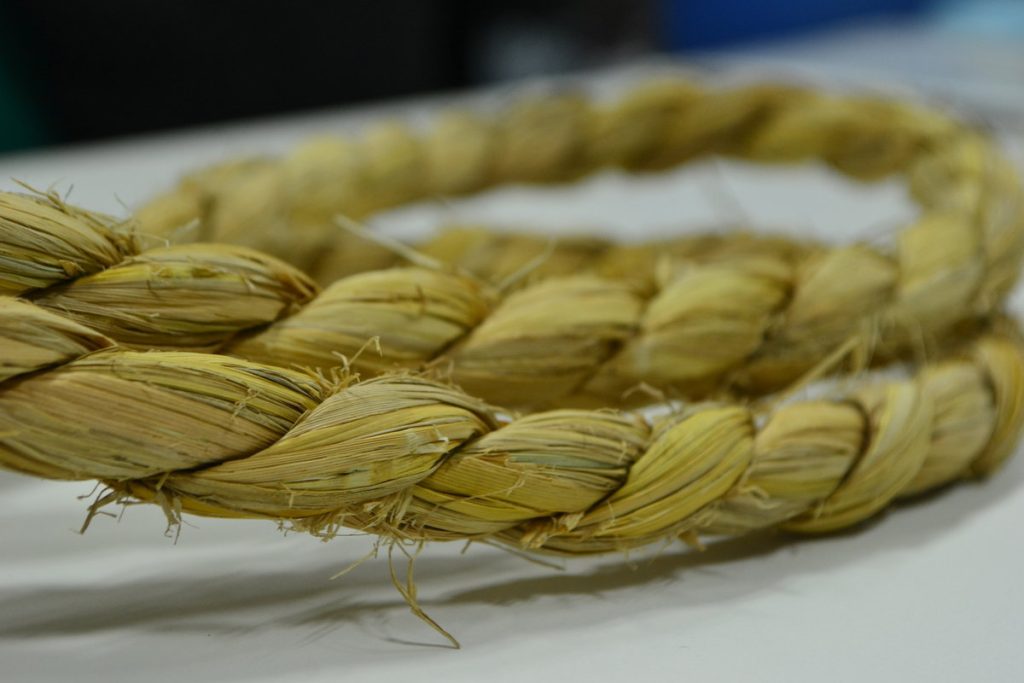
Because of the strong and constant friction during the Yamahoko parade, the ropes become rough and frayed like this.
Thanks to the ropes taking the impact instead, the huge floats are able to move so smoothly and beautifully.
After the parade, the ropes can no longer be reused as ropes. So, except for the pieces people take home, the rest are simply thrown away.
In this way, every year, each float uses about 5 kilometers of rope in total during the Yamahoko parade.
In closing
Among all the events of the month-long Gion Festival, the one thing I really hope everyone sees at least once is the float-turning performance during the Yamahoko parade.
The Gion Festival has many highlights, but the float turning is the most popular.
Powerful yet delicate, this float-turning performance is the climax of the Gion Festival.
Go straight from Kyoto Station to the Gion Festival! Use the MK Taxi Hachijo Exit Stand (VIP) for a smooth ride and helpful information.
Enjoy a comfortable trip to the Gion Festival with MK Taxi!
At the MK Taxi stand at Kyoto Station’s Hachijo Exit (VIP), you can get into a taxi quickly and smoothly.
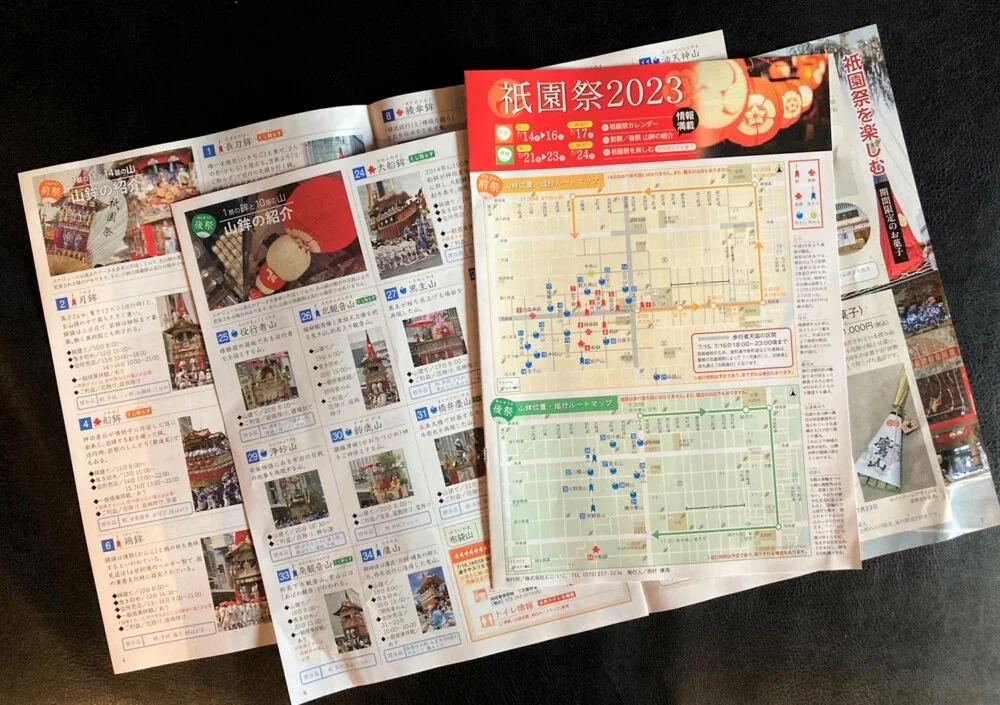
Also, at the MK VIP Station next to the taxi stand, free pamphlets and maps full of the latest Gion Festival information are available.
Even if you are not taking a taxi, you are very welcome to stop by.
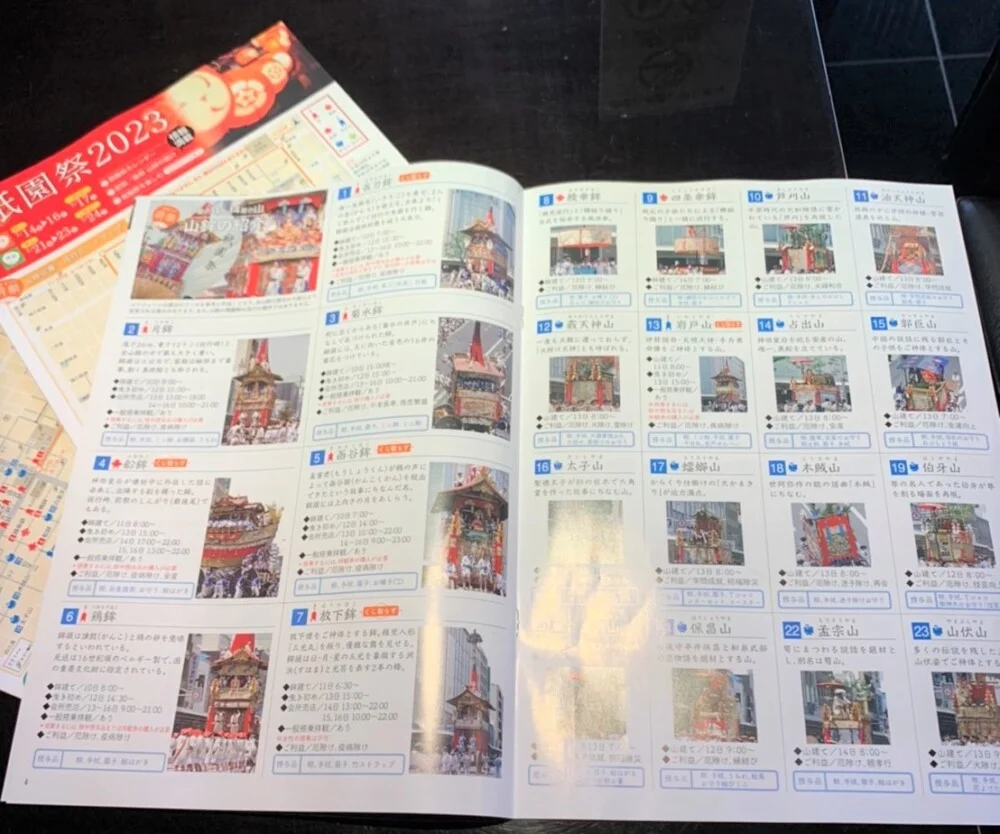
Get Gion Festival information at the MK VIP Station and enjoy the festival in a smarter, more convenient way.
In addition to sightseeing information, you can also use paid services such as luggage storage and stroller rental.