
Japanese White-eyes Gathering on Plum Blossoms
When we think of plum blossoms, not only their beautiful look and sweet smell are charming, but also the birds that come to them.
It’s not only people who love plum blossoms. Birds also love the nectar.
Watching Japanese white-eyes flying around and chirping to find nectar never gets boring.
Why do Japanese white-eyes gather on plum trees? Here, we will explain the relationship between plum blossoms and Japanese white-eyes, and introduce these birds that visit plum trees.
Small Birds Gathering on Plum Blossoms
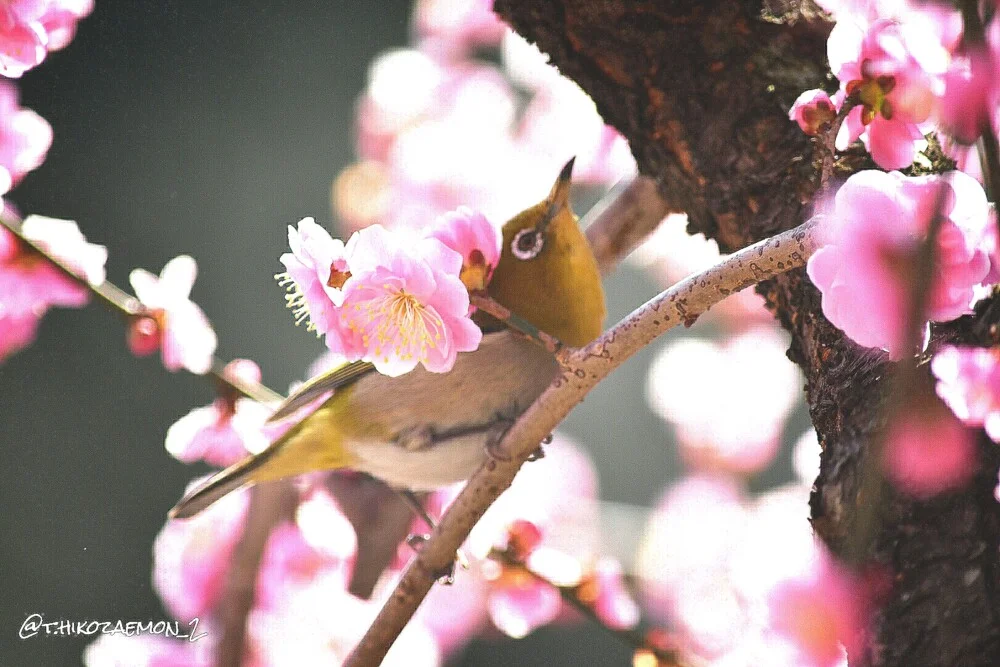
Plum nectar is a favorite food for small birds
Plum Blossoms Are Mainly Bird-Pollinated
Flowering trees are mainly divided into two types: bird-pollinated flowers and insect-pollinated flowers. Plum blossoms are basically bird-pollinated.
When birds drink the nectar, pollen sticks to their bodies. Then they carry it to another flower, and this helps the plum tree reproduce.
Without birds, plum trees would have a hard time leaving offspring.
For small birds, plum nectar is very attractive. It has a high sugar content, and in early spring—when there is still little food—it becomes a valuable source of nutrition.
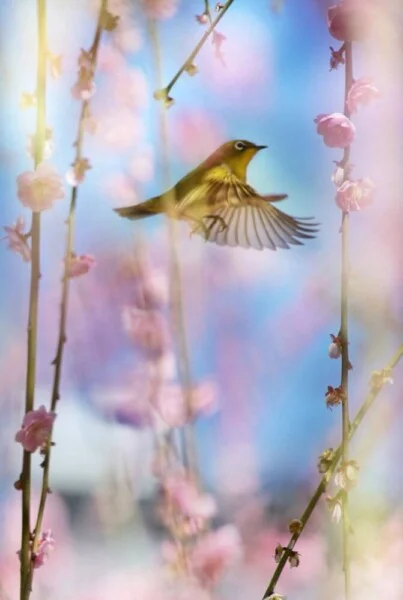
Plum Blossoms Bloom in Early Spring for Birds
Plum trees bloom earlier than cherry trees and other flowering trees partly because they are mainly bird-pollinated.
In early spring, temperatures are low, and insects like honeybees are not very active yet. But small birds are active all year round.
Before many insect-pollinated flowers start to bloom, the early-blooming plum blossoms stand out and become the main attraction.
Because the plum blossoms bloom first, many small birds gather and help carry pollen, so plum trees can reproduce more efficiently.
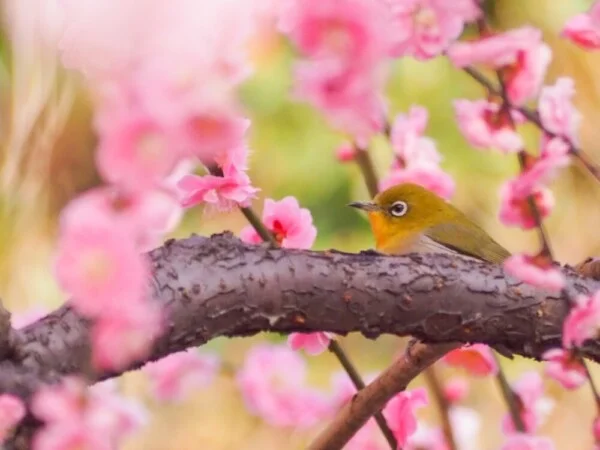
Plum Blossoms and the Japanese White-eye
What Is a Mejiro?
When people think of plum blossoms, they think of the Japanese white-eye.
It might even be more popular than the plum blossoms themselves.
The Japanese white-eye is a small bird in the order Passeriformes, family Zosteropidae, and genus Zosterops.
It is a resident bird, found from Japan to Southeast Asia, including southern China (Taiwan and Hainan Island).
It mainly lives in low mountains and forests, and it also lives in city parks and gardens, so people can often see it near where they live. It is not very wary of humans and often stays active close to people, so it is one of the easier small birds to observe.
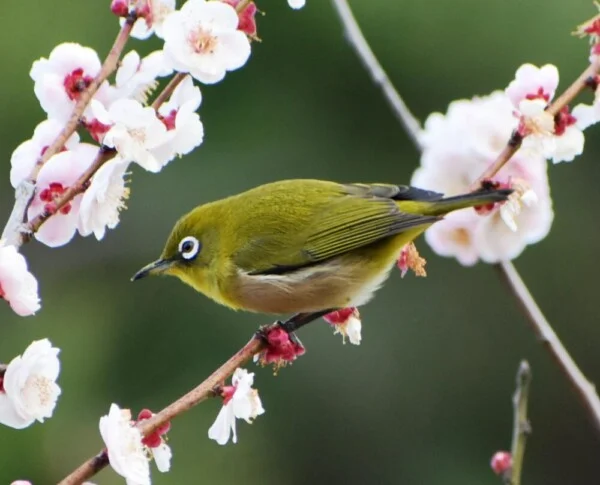
The Japanese white-eye has several charming features.
First is the white ring around its eyes, called an eye-ring.
The name “Mejiro” (meaning “white eye”) comes from this eye-ring.
Because the eye-ring is so white and stands out, the whole face looks brighter. Together with its round eyes, it makes a very cute expression.
Thanks to the eye-ring, it is easy to tell the Japanese white-eye from other small birds, even for beginners.
The Charm of Cute Japanese White-eyes
One charm of the Japanese white-eye is its cute, lively movement. Around the plum blossoms, they fly lightly from place to place.
After drinking nectar for a short time, they quickly hop to the next flower.
On the plum tree, you can see them flying around everywhere.
The Japanese White-eye’s Calls Are Also Charming
The Japanese white-eye’s voice is also part of its charm.
It has two kinds of calls: a simple everyday call like “chee-chee,” and a song-like call like “kyuru-kyuru.”
Like a small bird, its voice sounds very cute.
Conclusion
MK Taxi, which has worked in tourism in Kyoto for many years, has many sightseeing drivers who know Kyoto’s culture and history well.
Through in-house lessons and on-site study sessions, drivers can learn the basic knowledge needed for sightseeing. But beyond the basics, it depends on each person’s effort.
Each sightseeing driver has different strengths. Even in history, some are better with certain time periods. In culture, fields also vary, such as traditional culture, modern culture, art, and crafts.
Of course, many drivers also know a lot about food and flowers.
Some drivers may even be able to respond to requests like “I want to learn about birds such as the Japanese white-eye.”
Why not enjoy a slightly different Kyoto trip together with a professional in tourism and hospitality?
