
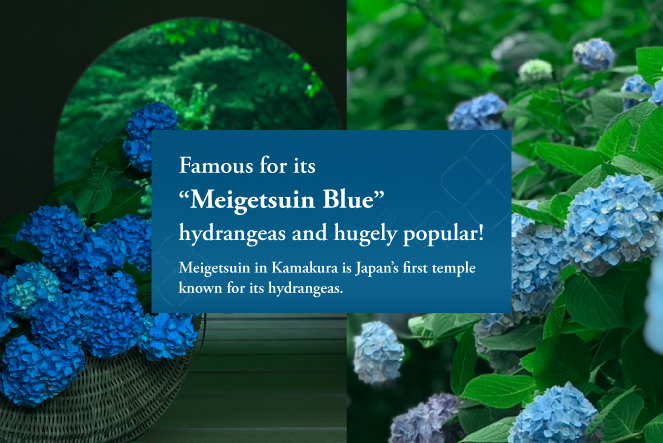
Meigetsuin is Japan’s first temple known for its hydrangeas
Kamakura, one of Japan’s historic capitals alongside Kyoto and Nara, is popular not only during the spring and autumn sightseeing seasons but also during the rainy season.
When the rainy season arrives, colorful hydrangeas brighten the streets of Kamakura, enhancing the charm and atmosphere of this ancient city. Among them, the most famous are the hydrangeas of Meigetsuin, known nationwide as “Meigetsuin Blue.”
Here is an introduction to Meigetsuin, one of Kamakura’s most celebrated hydrangea destinations.
Hime Hydrangeas of Meigetsuin Blue
Meigetsuin is widely known across Japan as one of the best places in Kamakura to enjoy hydrangeas.
The temple grounds are home to about 2,500 hydrangea plants, most of which are a variety called Hime Hydrangea.
This variety is believed to be a hybrid of Ezo Hydrangea, a mountain hydrangea type, and the common hydrangea.
Its flowers form round, ball-shaped clusters similar to those of common hydrangeas. The leaves, however, resemble those of mountain hydrangeas—they have a matte surface, a lighter color, and are generally smaller than those of common hydrangeas.
It can be quite difficult for non-experts to tell the difference by looking only at the flowers, but the leaves have a noticeably different texture and shine, making identification a little easier.
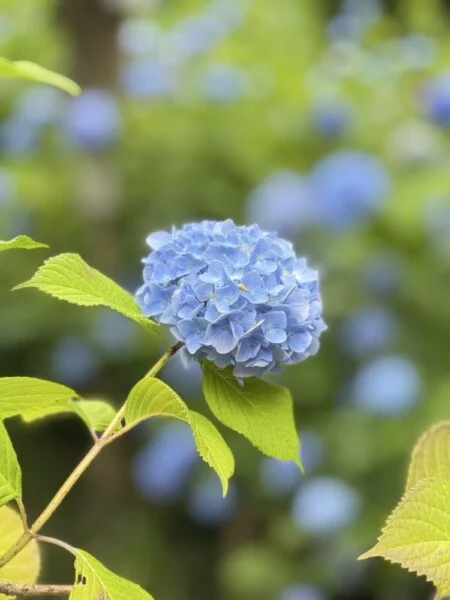
Because the name “Hime Hydrangea” is sometimes used for small-sized hydrangea varieties in general, this particular variety is also called “Makino Hime Hydrangea” in honor of its discoverer, Tomitaro Makino, when a distinction is needed.
Today, many cultivated garden varieties derived from Makino Hime Hydrangea have been developed. Possibly because it is less cold-tolerant than common hydrangeas, it is not often seen in Kyoto. However, visitors can still find Hime Hydrangeas at the Kyoto Prefectural Botanical Gardens and the Uji City Botanical Park.
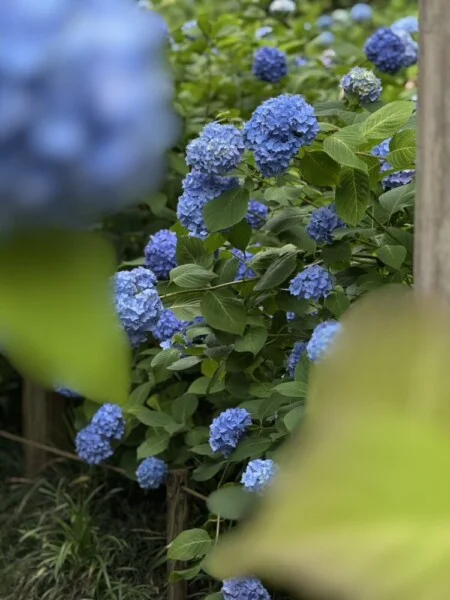
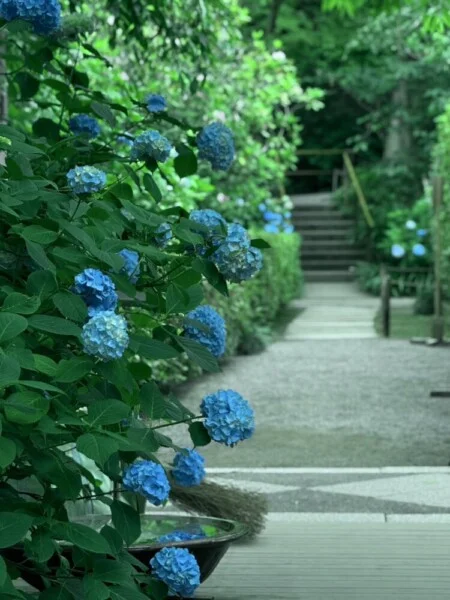
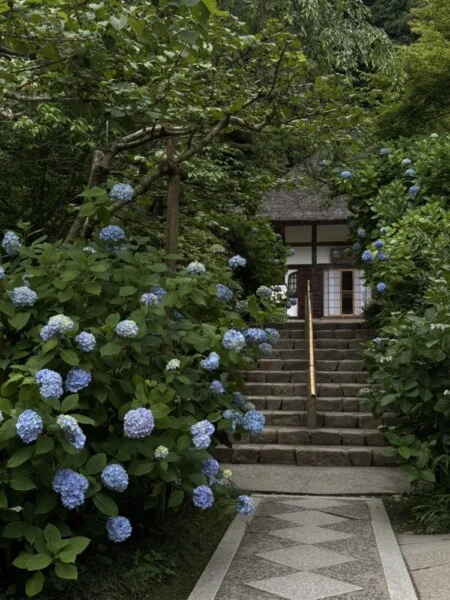
The hydrangeas at Meigetsuin are known for their vivid blue color. During the blooming season, the entire temple grounds seem to be covered in blue, creating a stunning and dreamlike scene. This distinctive shade is known as “Meigetsuin Blue.”
It is unclear exactly when the term “Meigetsuin Blue” first came into use, but it does not appear to be a recent name.
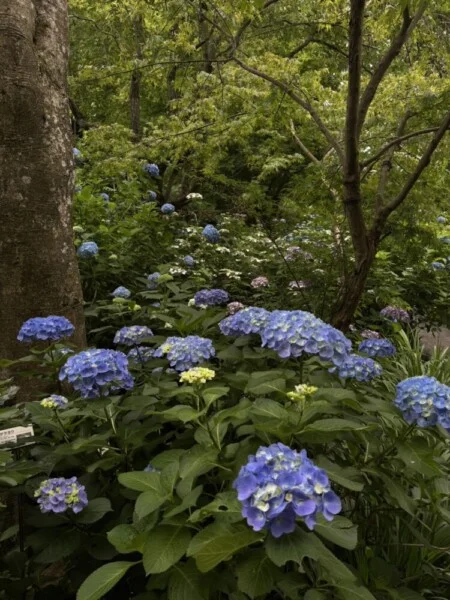
The temple grounds are densely planted with hydrangeas, creating what feels like a beautiful “hydrangea tunnel” when they are in full bloom.
However, because it is such a famous sightseeing spot, the hydrangea season brings huge crowds. It can be packed with visitors everywhere, so be prepared if you plan to visit during this time.
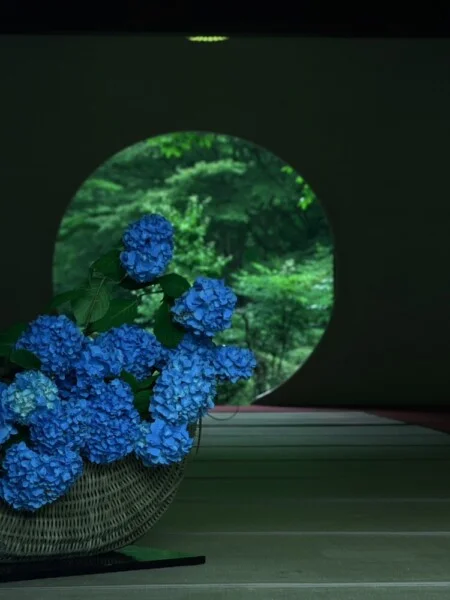
One of the highlights of Meigetsuin is the “Window of Enlightenment” in the main hall.
This circular window, a distinctive feature of Zen temples, symbolizes the universe and spiritual completeness.
In front of the Window of Enlightenment, hydrangeas known as “Meigetsuin Blue” are beautifully arranged, creating a striking and harmonious view with the window.
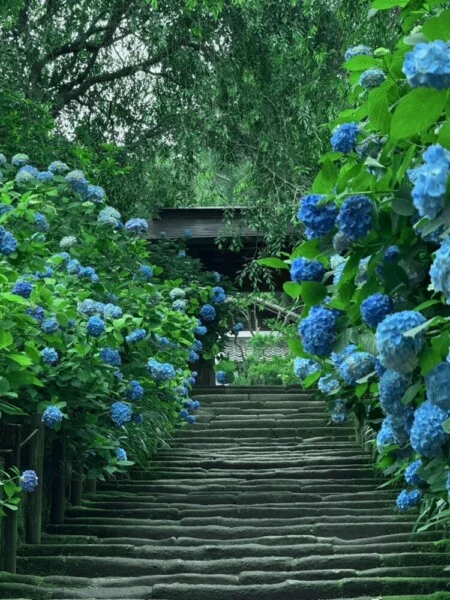
Japan’s First “Hydrangea Temple”
Today, temples known as “Hydrangea Temples” can be found throughout Japan, and hydrangeas are among the country’s most popular seasonal flowers, rivaling cherry blossoms and autumn leaves in popularity.
However, the widespread popularity of hydrangeas as we know it today is actually a fairly recent development.
Until some time after World War II, people mainly appreciated hydrangeas as individual plants, and there was little tradition of enjoying large-scale displays of hydrangeas growing in clusters.
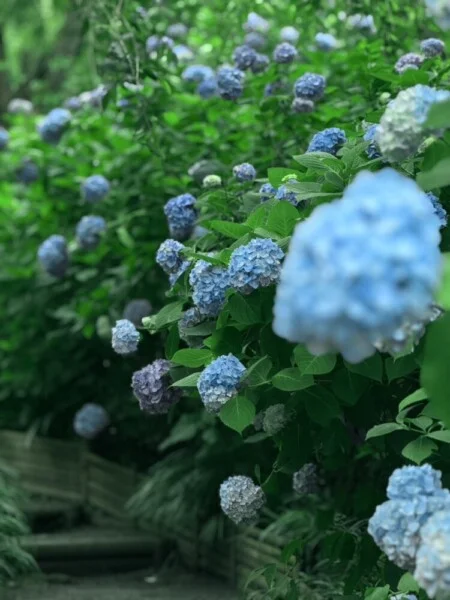
Among the many temples now known as “Hydrangea Temples,” the first to gain widespread fame for its hydrangeas was Meigetsuin in Kamakura.
As early as the 1960s, the beauty of Meigetsuin’s hydrangeas had already become widely admired. By at least 1965, it was being referred to as a “Hydrangea Temple.”
For some time afterward, the term “Hydrangea Temple” was used almost exclusively for Meigetsuin. In other words, “Hydrangea Temple” essentially meant Meigetsuin.
Originally, Meigetsuin was not a tourist-oriented temple and lacked the facilities needed to accommodate large numbers of visitors. As crowds flocked to the temple during the hydrangea season, the impact became so significant that the term “hydrangea pollution” had already appeared by the 1970s to describe the problems caused by the overwhelming influx of tourists.
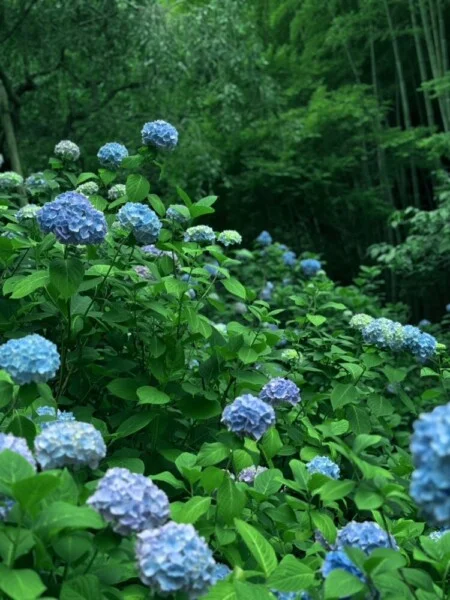
Hydrangeas began to be planted at Meigetsuin around 1951. Considering the temple’s long history, this is actually a relatively recent development.
The story began when the temple happened to receive some Hime Hydrangeas and planted them around the grounds as a substitute for hedges.
Just over a decade later, the hydrangeas had become a major attraction. The climate and soil of Meigetsuin, located in the moist Meigetsu Valley, were likely a perfect match for Hime Hydrangeas, which are particularly sensitive to dry conditions compared with other hydrangea varieties.
Originally, these hydrangeas were planted simply as a practical hedge rather than as a tourist attraction. Yet through a fortunate coincidence, they gave rise to the famous “Meigetsuin Blue.”
It is said that the crowds became so overwhelming that even the temple’s head priest at the time was surprised and bewildered by the level of popularity.
About Meigetsuin
Meigetsuin was founded in 1159 during the first year of the Heiji era to honor the memory of Toshimichi Yamauchi-Sudo, who was killed in the Heiji Rebellion.
In 1380, when Zenkoji Temple, one of the prestigious Ten Great Zen Temples of the Kanto region, was restored, Meigetsuin became one of its subordinate branch temples.
During the anti-Buddhist movement of the Meiji period, Zenkoji was abolished, but Meigetsuin survived and remains standing today.
Although Meigetsuin is a historic temple with a long heritage, it was once a relatively modest presence in Kamakura, an ancient city filled with famous temples and renowned landmarks.
However, during the rainy season, the temple is transformed by its spectacular hydrangeas and becomes one of the most popular attractions in all of Kamakura.
Visitor Information
- Opening Hours: 9:00 AM – 4:00 PM (closing time)
- Admission Fee:
- High school students and above: 500 yen
- Elementary and junior high school students: 300 yen
- Rear Garden of the Main Hall: Additional 500 yen
- Address: 189 Yamanouchi, Kamakura, Kanagawa, Japan
Access: About a 10-minute walk from JR Kita-Kamakura Station.
