
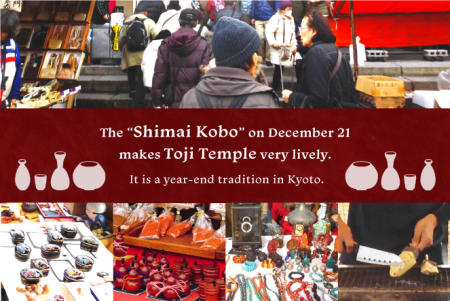
The “Shimai Kobo” on December 21 at Toji Temple
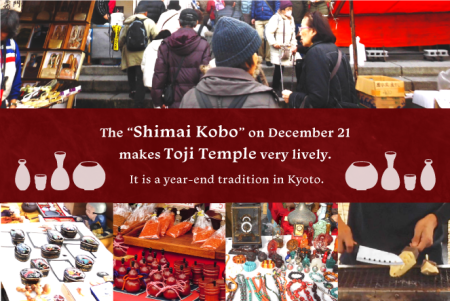
When people talk about Kyoto at the end of the year, they think of the “Shimai Kobo” held at Toji Temple on December 21.
The Kobo Market is held at Toji Temple on the 21st of every month, but the busiest one of the year is on December 21.
On this day, people come not only to buy antiques, but also to buy items for the New Year. Even in the cold weather, the temple grounds are full of energy and crowds.
Let’s go to Shimai Kobo
About Shimai Kobo on December 21
At Toji Temple, a market called the Kobo Market is held on the 21st of every month.
This market is held together with a Buddhist ceremony called “Mieku,” which takes place on the 21st, the day Kobo Daishi Kukai entered eternal meditation.
People believe that visiting Toji Temple on the 21st brings greater blessings than usual, so shops started to sell goods for the many visitors.
Even today, Toji Temple is crowded with worshippers on the 21st of every month.
Among them, “Hatsu Kobo” on January 21 and “Shimai Kobo” on December 21 are especially busy and full of people.
It is said to be one of the largest temple markets in Japan.
New Year items line the streets
Things you need for the New Year
The Kobo Market at Toji Temple is one of the largest markets in Kyoto, with about 200,000 visitors each month.
The busiest one is the “Shimai Kobo” held on December 21.
At the Shimai Kobo on December 21, just before the New Year, many New Year items are sold.
You can find shimenawa ropes, ornamental cabbages, New Year decorations, and salted salmon.
People come not only from Kyoto, but from all over Japan.
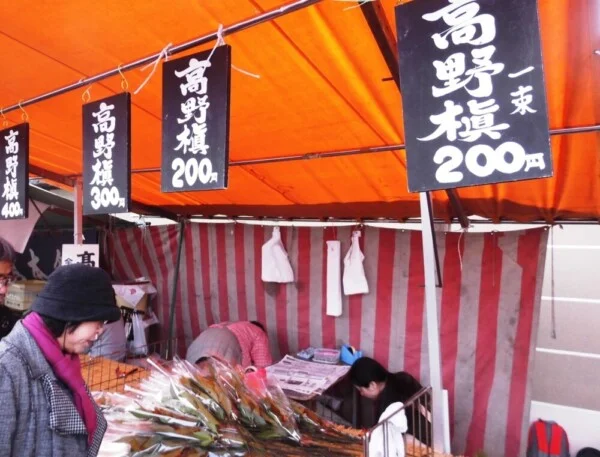
At the Shimai Kobo on December 21, many stalls come out, so many that they overflow from the temple grounds.
They sell many kinds of things: foods like chili peppers and pickles, clothes, handmade goods, antiques, and plants such as potted trees and seedlings.
There are truly many different shops. It feels strange: messy, but still well organized.
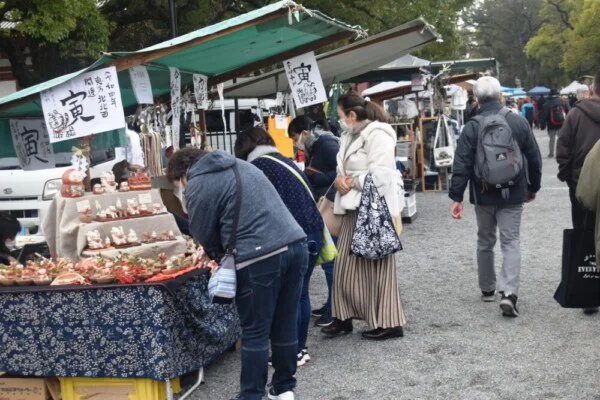
Every year at Shimai Kobo, there are stalls selling goods related to the twelve zodiac animals of the New Year.
Shimai Kobo is also popular with foreign visitors
At the Shimai Kobo on December 21, there are many New Year items, but also many different kinds of goods.
Before the COVID period, many foreign tourists came to Shimai Kobo to look for unique Japanese items.
Even if they cannot speak Japanese, it is interesting to see how they communicate well using gestures.
At the Shimai Kobo in 2025, we will likely see many foreign tourists again.
The Kobo Market at Toji Temple is a perfect place to look for antiques and hidden treasures.
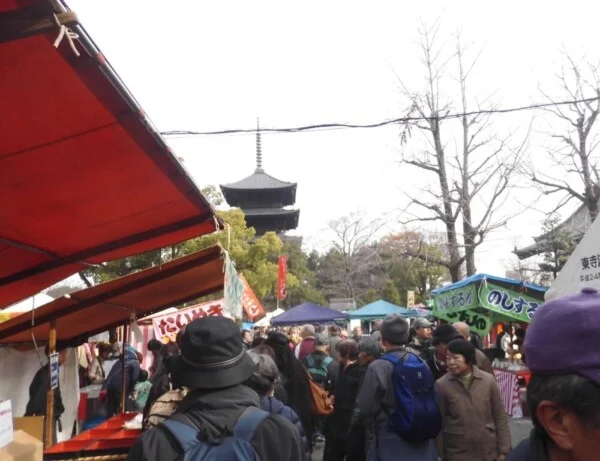
Under the cold winter sky, with the five-story pagoda in the background,
the lively voices of vendors at Shimai Kobo create a true year-end feeling.
This scene can only be seen at the Shimai Kobo on December 21.
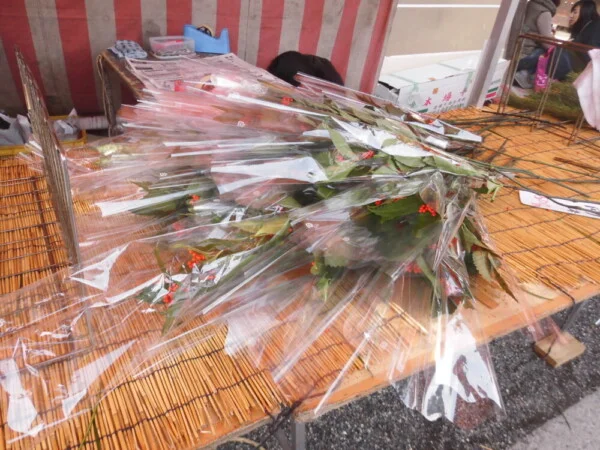
Shimai Kobo sells everything
Not only antiques and art
At the Kobo Market at Toji Temple,
you can find many items that you would never see in a normal antique or art shop.
You may think, “They even sell this?”
This is even more true at Shimai Kobo, which has the most stalls.
Some items look like simple junk at first,
but to the right person, they are real treasures.
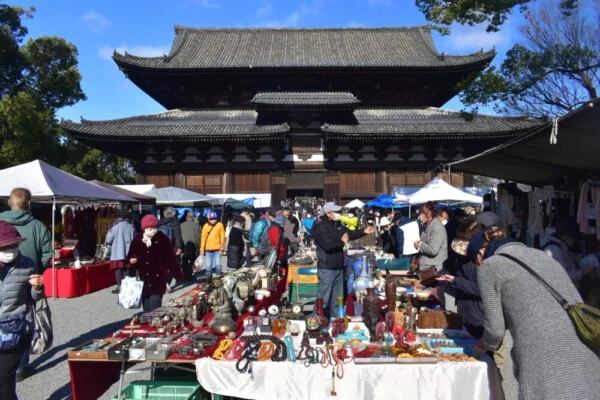
Visiting early in the morning is recommended
The opening and closing times of stalls at Shimai Kobo are different for each shop.
Some vendors prepare from the night before and open early in the morning,
while others start slowly after the morning begins.
Closing times also vary,
so whether your favorite shop is open can depend on luck.
Some stalls even close in the early afternoon.
If you want to fully enjoy the lively Shimai Kobo,
it is best to wake up early and visit first thing in the morning!
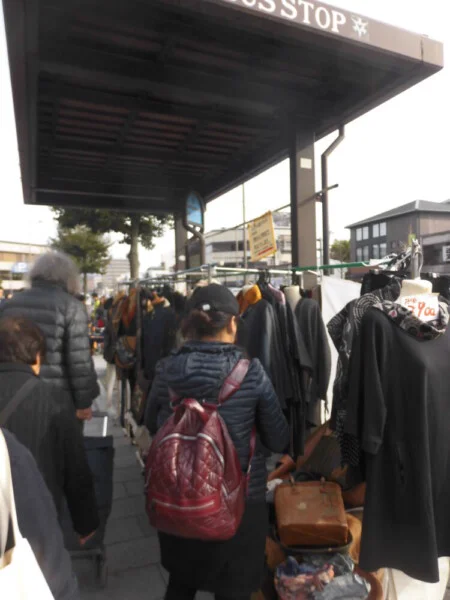
The Shimai Kobo on December 21 is open all day,
but going early in the morning is the key to finding good deals.
In the morning, there is the widest selection of items,
and the temple grounds are not very crowded yet.
You can take your time to look for what you want.
Late December mornings are very cold,
but this is a good reason to wake up early.
Let’s go “treasure hunting” at Shimai Kobo!
The Kobo Market at Toji Temple is run by professionals
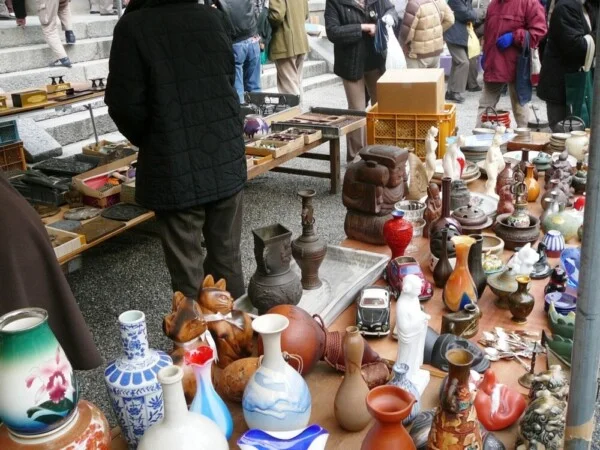
At first glance, the Kobo Market at Toji Temple looks like a big flea market.
However, most of the vendors are professional antique dealers.
People who run antique shops usually come to sell here on the 21st of every month.
Sometimes, other professional dealers also come as customers
to look for special items.
The biggest difference from a normal flea market
is that the items here are chosen by expert eyes.
Because the sellers are professionals,
you can talk with them and ask questions before buying.
If you ask, “Do you have something like this?”
they may show you the perfect item.
Even if they do not have it,
they might tell you another shop that does.
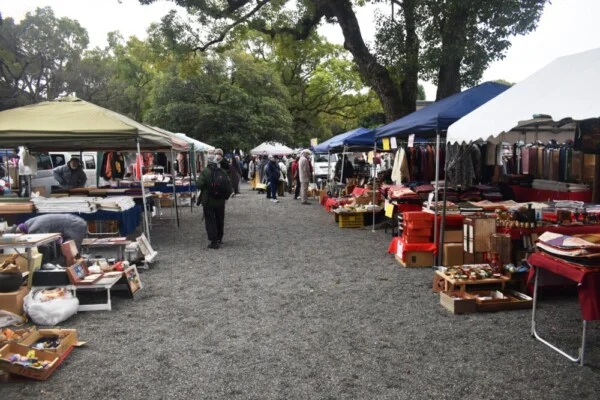
With so many stalls, Shimai Kobo truly feels like a “treasure hunt.”
Even if you are not interested in antiques or art,
old toys and retro household items will surely catch your eye.
If you walk around with energy and focus,
you will likely find something you really want.
This kind of treasure hunting is the true charm of the Kobo Market at Toji Temple.
Test your skills with price bargaining
At the Kobo Market at Toji Temple, bargaining is welcome.
Prices of antiques and art are not fixed.
To someone who wants it, an item can be priceless,
but to someone else, it may just be old stuff.
Why not try bargaining at least once?
You might get your favorite item at a surprising price.
Some items do not even have price tags.
The conversation during bargaining
can also become a good memory of the market.
Since most shops come every month,
there is little need to worry about being overcharged.
Trust is very important in this business.
In the late afternoon, some vendors lower their prices,
so bargaining later in the day is often easier.
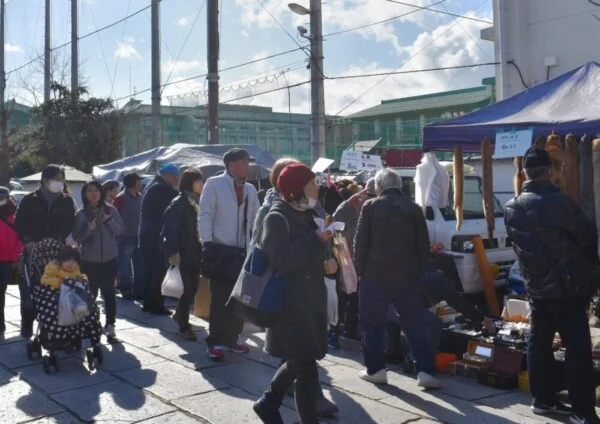
When people think of antiques or old art,
they often imagine very expensive items.
However, at the Kobo Market at Toji Temple,
you can find many things at affordable prices.
Some items cost only 100 yen,
or several items for 1,000 yen.
Even similar items can have different prices at different shops.
Payment at stalls is mainly in cash,
but some shops accept PayPay.
There are also shops that accept credit cards.
In China, cashless payment is common even at street stalls,
so one day this may also become normal at the Kobo Market at Toji Temple.
Not only antiques, but also food
You can also find daily goods and art items
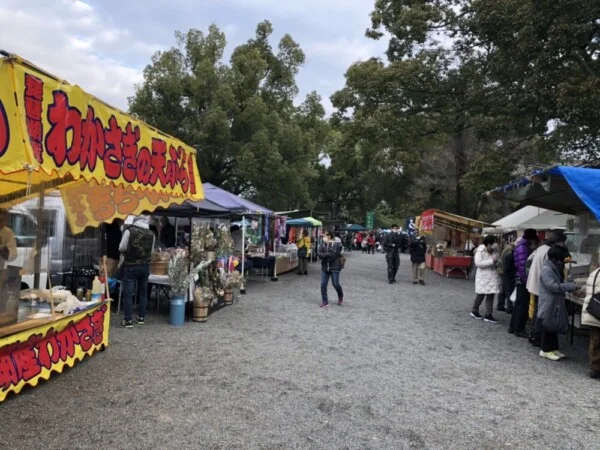
At the Kobo Market at Toji Temple,
there are not only antique shops.
In fact, there are even more shops selling other things.
You can find cute handmade accessories,
stylish daily goods made by ceramic and wood artists,
artworks by creators,
and both Japanese and Western second-hand clothes.
Today, the market is a place where anyone might find something special.
Even if you are not interested in antiques,
you should visit Shimai Kobo on December 21 at least once.
There are also many food stalls, perfect for eating while walking

When you need a small break from shopping,
food stalls help fill your stomach and add to the festival mood.
Not only takeout is available,
many stalls also have seating areas,
so you can rest and enjoy the Kobo Market at Toji Temple even in the cold weather.
You can find classic festival foods everywhere,
such as takoyaki, okonomiyaki, and yakisoba.
In the cold season, like the Shimai Kobo on December 21,
there are food stalls selling warm dishes such as oden and udon.
Since you are there,
it is a good idea to try special stalls unique to Shimai Kobo,
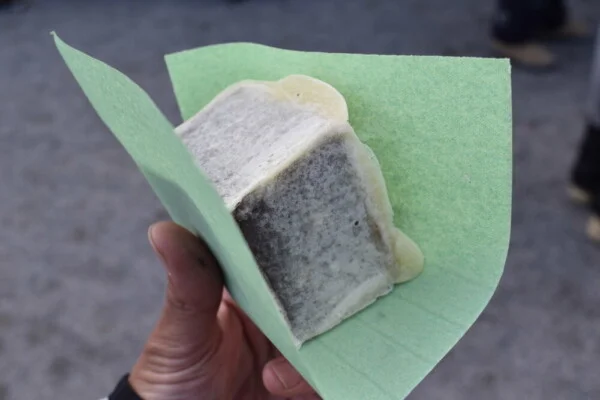
such as grilled dango, kintsuba, and chestnut manju.
The lucky kintsuba (140 yen)
often sells out around noon, so be careful.
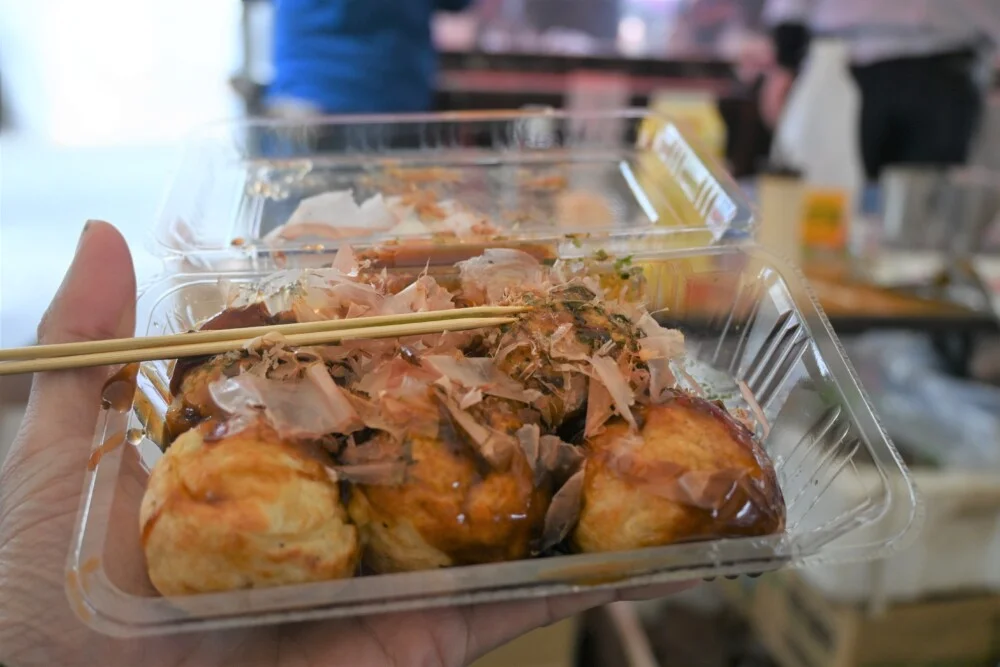
There are several stalls selling classic foods like takoyaki, okonomiyaki, and yakisoba.
With okonomiyaki and yakisoba, you can see clear differences in the ingredients.
Takoyaki, on the other hand, looks almost the same at every stall.
However, the most popular one is the takoyaki stall on the north side of the dining area.
It has a rich dashi flavor and a soft, creamy texture, and tastes very good.
As for prices,
takoyaki is about 300 yen for 5 pieces,
and okonomiyaki or yakisoba costs around 500 to 600 yen per plate.
These are normal everyday prices, not festival prices.
At some times of the day, prices may be even lower.
Conclusion
The Shimai Kobo on December 21 is fun even just to look around,
with so many different things for sale.
But before you know it, you may buy too much,
and taking everything home can be hard.
At the Kobo Market at Toji Temple,
you cannot send items home by delivery like in normal shops.
In that case, using MK Taxi is a good option.
They can take you straight home with your important purchases, without transfers.
So relax, enjoy shopping,
and have a great time at the Shimai Kobo on December 21.
For sightseeing in Kyoto, leave it to MK’s chartered sightseeing taxi.
Your private driver is a Kyoto expert who handles both transport and guiding.
