
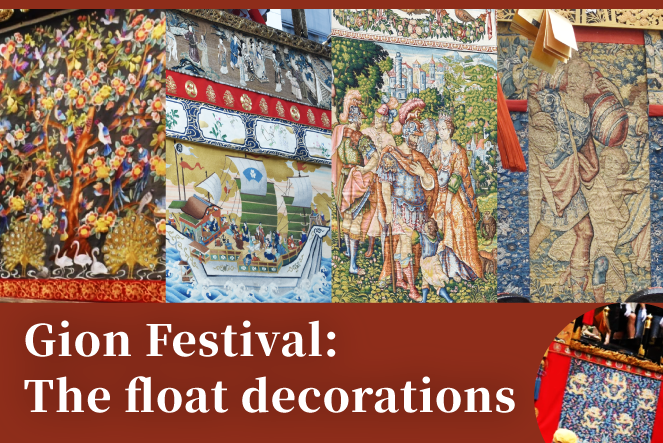
Gion Festival: The float decorations
The float parade at the Gion Festival is also called a “walking museum” because of its gorgeous decorations.
It is amazing that some of the decorations carefully passed down by the townspeople include tapestries made in 16th-century Belgium.
When you come to see the Gion Festival, please also take a close look at the decorations on the floats.
The refined taste of Kyoto people, shown in how they embraced things from the West
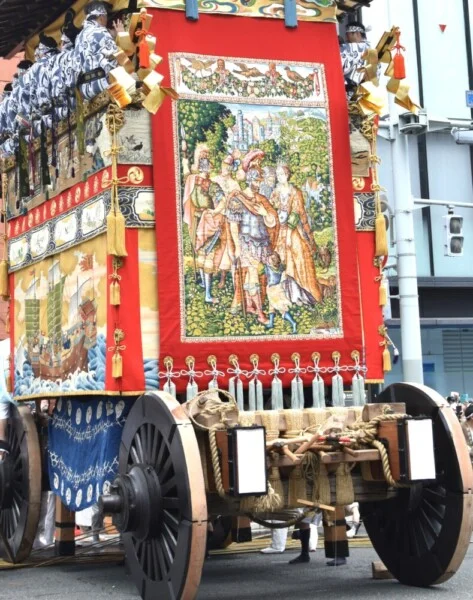
From the Azuchi-Momoyama period to the Edo period, each float in the Gion Festival began to compete with more luxurious decorations.
In addition to Nishijin textiles, some Gion Festival floats also appeared with Gobelin tapestry decorations. Gobelin tapestry is a type of French textile, known for its fine craftsmanship and vivid colors.
The ornaments and curtain fabrics used to decorate the floats are called “kesohin.”
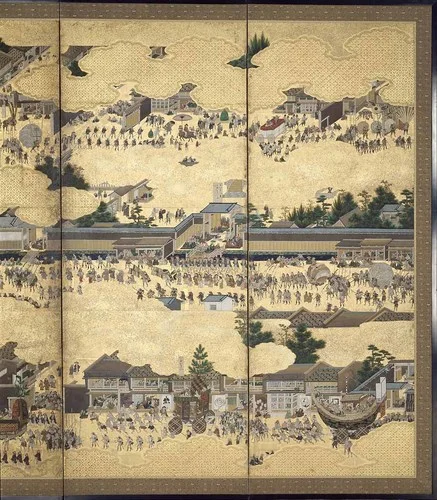
For example, the rear decoration on the Rooster Float is a tapestry made in Belgium in the 16th century.
It was originally one large tapestry, later divided into three parts. The other two parts are used as the front decoration of the Arare Tenjin Float and as the rear decoration of the Phoenix Float at the Nagahama Festival in Shiga Prefecture.
Similarly, the front decoration of the Bai Letian Float is also a tapestry made in Belgium in the 16th century. This tapestry was also divided into three parts, and the other two are used as rear decorations on the Moon Palace Float and the Dragon Gate Waterfall Float at the Otsu Festival in Shiga Prefecture.
These tapestries are thought to have come to Japan through trade with the West around the end of the 16th century, but the details are still unclear.
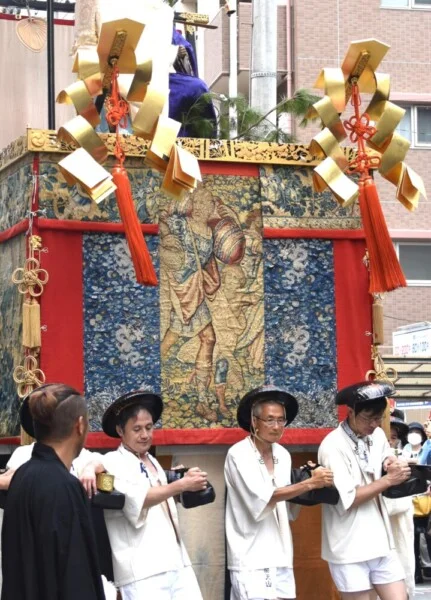
At that time, the Gion Festival already had a history of several hundred years. Yet the people of Kyoto freely used things from the West to decorate their floats, showing their refined sense of style.
People often think of Kyoto residents as conservative.
However, Kyoto has produced companies such as Kyocera, Nintendo, and Nidec, and it also has the highest bread consumption in Japan. These facts show that Kyoto people also have a love for new things.
Even today, float decorations are newly made with the finest traditional craftsmanship
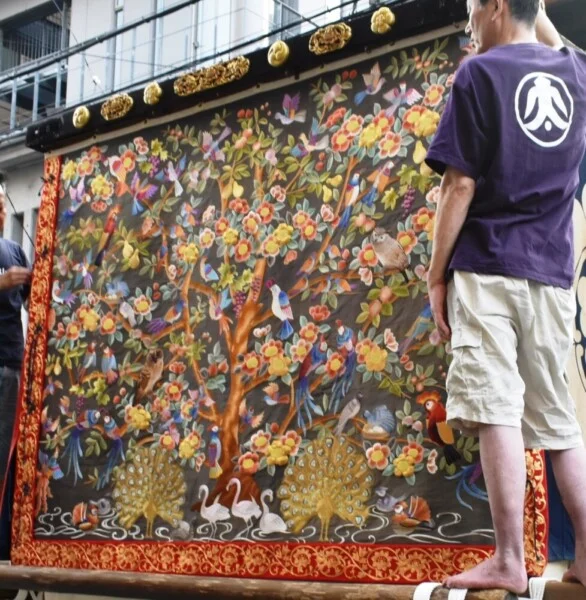
Many textiles handed down from ancient times are designated as Important Cultural Properties. This is why the floats of the Gion Festival are called a “moving museum.”
A special point for Kyoto people who have watched the festival for many years is to enjoy the floats from all sides, including the sides and the back, not just the front.
Every year, some float receives newly made decorations, so checking out the new decorations is also part of the fun.
Sometimes they are restored and remade based on the original design, while other times they are made with a completely new design.
Either way, the pressure on the craftsmen is huge. But meeting that challenge is the pride and spirit of the craftsmen involved in the Gion Festival.
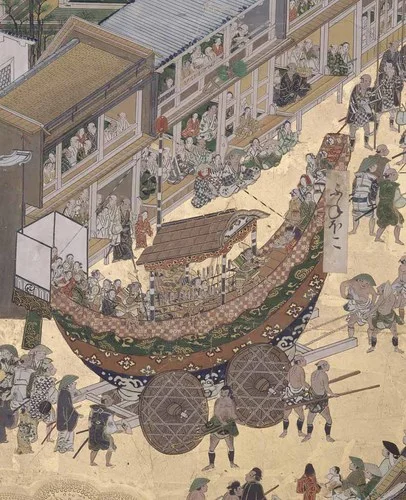
The rear decoration of the Rooster Float mentioned earlier is now a newly made version completed in 2003. It took two years and cost 30 million yen.
Of course, the original piece is also carefully preserved.
Each new decoration is made using the finest traditional techniques that Kyoto is proud of.
By gradually replacing old decorations with new ones, the people of Kyoto have kept the Gion Festival alive for more than 1,000 years.
And by continuing to create new pieces, these valuable skills have been passed down in Kyoto for many generations.
The lower decorative curtains of the Rooster Float were newly completed in 2022
The work began in 2017, with one piece made each year, and was finally finished.
They include a second-layer curtain made of scarlet wool cloth with sacred crests and other patterns, and a third-layer curtain below it showing flowers and birds of the four seasons.
For the new third-layer curtain, the design was based on a painting by Matsumura Keibun, just like the previous lower curtain.
It was the first renewal in about 200 years.
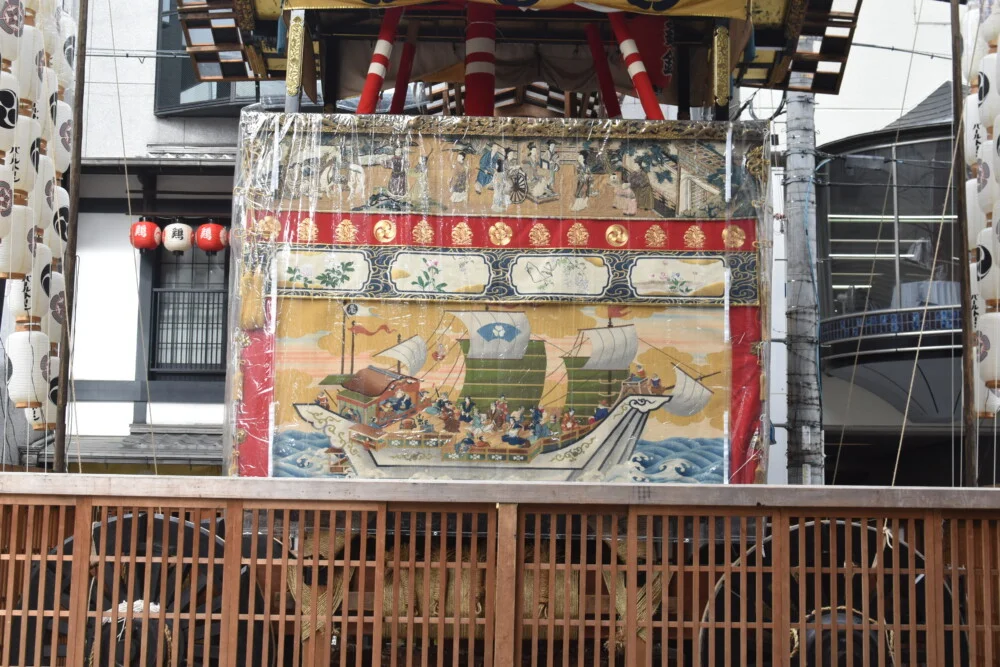
The front hanging and decorative curtain of Hakurakuten-yama, newly made in 2023
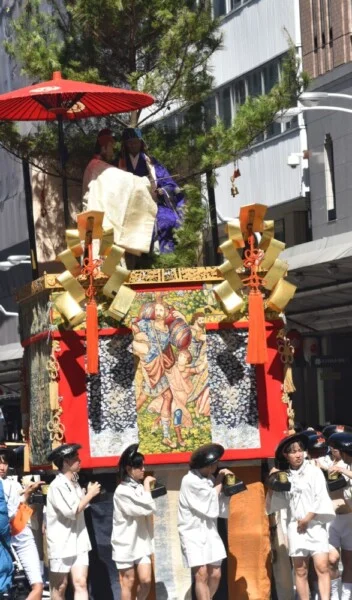
The lower decorative curtain of the Hoka-hoko float, newly made in 2023
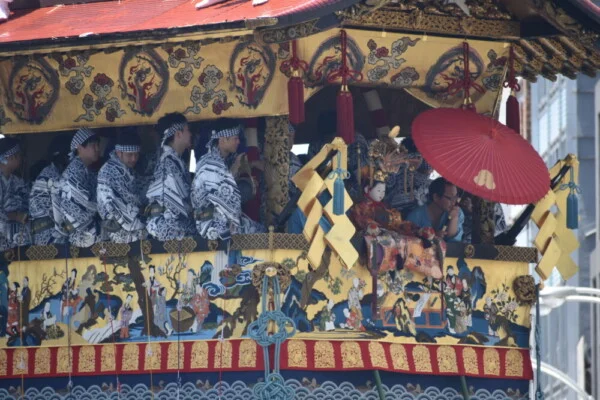
The front hanging of Hashi Benkei-yama, newly made in 2024
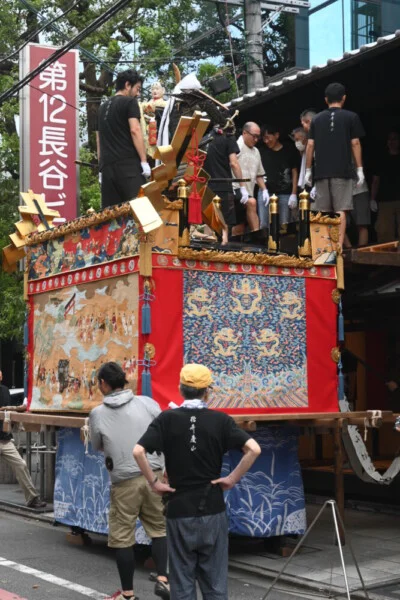
The decorative curtain of the Ofune-hoko float, newly made in 2025
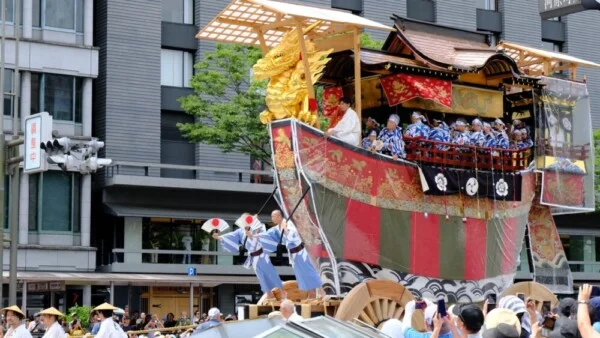
Ms. Jeong Suk-hyang, a Korean female Japanese-style painter who created the original design for Hachimanyama’s decorative curtain “Ten Symbols of Longevity” at the Gion Festival
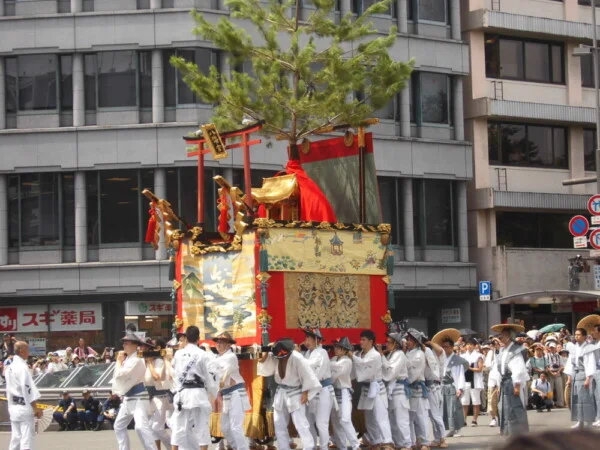
I can only keep drawing steadily
——The Hachimanyama float’s hanging, Ten Symbols of Longevity, has become a topic of attention.
It was unveiled on Friday, and I suddenly found myself surrounded by famous people. The next day, there was a press conference. When it was all over, my heart felt empty.
So on Saturday and Sunday, I escaped to Yasu and lay down in a wheat field. After two days, I felt as if the dirt in my heart had been washed away, and then I came back.
I really felt like a woman working in the fields. I thought I could only keep drawing steadily.
—I hear that quite a few decorations used in the Gion Festival were made in Korea.
We have come to learn that many items once believed to be from the Ming dynasty were actually made in Korea.
It seems that this was one reason they decided to ask me to paint this time.
—The result is wonderful.
Professor Motoi No said, “The unseen power of women was great.” Both the original drawing and the embroidery were done by women.
The sense of the embroiderers was amazing. They expressed the tiger’s fur and the sense of distance so clearly that even the designer was surprised.
—Still, why Japanese-style painting?
Korea is centered on ink painting. Color painting existed in folk paintings and Buddhist paintings until the Joseon period, but it later declined.
Today, when people talk about color painting, they usually mean Western painting.
—That is surprising, since Korea has such a strong image of vivid colors.
Ink painting is spiritual, but I felt that ink alone was not enough. I wanted to learn color, so after I married my husband, who was studying in Korea at the time, I went to study in the Japanese-style painting department at Kyoto University of the Arts.
So for two years, we were separated like lovers on Tanabata.
—Is that painting on the wall, The Tale of Genji picture scroll, a copy?
In Korea, I studied ink painting and the Four Gentlemen, and practiced brushwork. In Japan, I studied copying. In a way, I took a very long path.
There are not many people who are still unknown at forty-two. People who were in the same class as me are already mid-career artists back in Korea.
She is like an older sister to the young Korean artists studying at Kyoto University of the Arts. She seems very caring.
They respect their seniors, so whatever they do, they always check first before acting. They all came here through different paths, but they are working very hard.
We have also held group exhibitions together. It is the first time that Korean students have gathered like this at the art university, and I think it is important to leave Japanese students with a good image of Korea.
Even though the two countries are close, there are so many negative stories. People who go there with good intentions understand and speak well of it, but some people who go only as tourists say harsh things.
That makes me feel frustrated. I am not especially a patriot, and I am not a politician either.
Jeon Suk-hyang
1944 Born in South Jeolla Province, Korea
1967 Selected for the Korean National Art Exhibition
1968 Graduated from the Department of Oriental Painting at Hongik University
1973 Studied in the graduate program of Japanese-style painting at Kyoto University of the Arts
1976 Completed the program
1976 to 1977 Held solo exhibitions in Kyoto and Seoul
1978 Exhibited at the International Art Exhibition in Seoul
1983 and 1985 Held solo exhibitions at Tawaraya Gallery
1979 and 1980 Published the folk tale picture books Haennim and Dalnim and Heungbu and Nolbu
Member of the Korean Art Association and affiliated with the Soga-kai
For sightseeing in Kyoto, leave it to MK’s chartered sightseeing taxi.
Your private driver is a Kyoto expert who handles both transport and guiding.

Gion Festival Feature Articles
